HISTORICAL FIGURES IN THE BOOK
This is where all the real historical figures in the book are listed in chronological order of appearance, with sources and photos. An space for those interested to look further into the book, find out some of the facts about incredibly consequential characters, and research the complex relationships between these real people. Some personal characters are omitted for the authors sake. Japanese and Chinese names will be listed under their surnames (which come first), eg Mao Zedong will be under M. Unfortunately a desktop view is neccessary to view this page
Enter or Shift Enter to move between highlighted names in search
List of historical figures by order of appearance in the book
Prologue:
Beate Sirota-Gordon
Augustine Sirota
Leo Sirota
Toyama Mitsuru
Richard Sorge
Baron Takahashi
Hermann Baerwald
Chapter 2: The Apprentices
Baron Armand von Rothschild
Felix Warburg
Sassoons
Rothschilds
Goldschmidts
Seligmans
Oppenheims
Lehmans
Karl / Paul Baerwald
Moses Mendellsohn
Max von Oppenheim
Sir William Crookes
Fritz Haber
Albert Einstein
Emperor Meiji
Carl Duisberg
JD Rockefeller
Gustav Krupp
Saigo Takamori

Baerwald, Paul (Karl)

Sources:
Britannica Encyclopædia Britannica, Inc.
Chapter 3: The Lovers
Sun Yat-Sen
Emperor Taisho (Yoshihito)
General Erich von Falkenhayn
Kaiser Wilhelm II
Governor Mayer-Waldeck
Colonel Toyohisa Matsue
Clara Haber/Immerwahr
Rosa Luxemburg
Otto Hahn
Gustav Hertz
Hermann Hanssen
Marquis Yorisada Tokugawa
Dan Takuma
Carl Bosch
Viscount Hidemaro Konoe
Chichibu, Prince Yasuhito
Chapter 4: The Assasins
Ryohei Uchida
Kodama Yoshio
Prime Minister Hara
General Nomura
Gregor Piatigorsky
Emperor Hirohito Crown
Prince Takamatsu
Patriot' Nakaoka Kon'ichi
Musashi Miyamoto
Vice Chancellor Erzberger
Victor Sasson
Cyrus Woods
Jascha Heifetz
Prince Yasuhito Chichibu
List of historical figures alphabetically by surname:
Arnold, Thurman (Attorney General)
Chapter 5: The Quickening
Pu Yi
Junnosuke Inoue
Allen Dulles
Israel Epstein
Wang Ching-Wei
General Doihara
Mao Tse-Tung
Mickey Hahn
Jim Rasbury
Nobusuke Kishi
Sasakawa Ryoichi
Thurman Arnold (1891–1969) was a lawyer and antitrust enforcer who Is notable for speaking up and demonstrating the links between American businesses and the businesses of the Nazi Regime, as mentioned in the book. Appointed Assistant Attorney General in charge of the Antitrust Division in 1938, Arnold became arguably the most aggressive trust-buster in the division's history bringing over 100 cases. Using congressional testimony and public speeches, Arnold exposed what he described as an "international cartel movement loosely associated with Nazi Germany," arguing that these business arrangements had actively crippled American productive capacity in the pre-war period and reporting to the Truman Committee, he revealed a list of 162 agreements between IG Farbenindustrie and American corporations.
Sources:
George Charles Beresford (1864-1938), Public domain, via Wikimedia Commons
Chapter 6: The Americans
Colonel Charles Willoughby
Ed Lansdale
General MacArthur
Bill Donovan
Queen Min
Attorney General Thurman Arnold
General LeMay
Kojima Kashii
Santy Romana
Reinhard Gehlen
Frank Wisner
Baerwald, Hermann
German educator; born at Nakel, in the province of Posen, Nov. 7, 1828. His academic education began at the gymnasium of Konitz, continued at the Elisabeth-Gymnasium of Breslau, supplemented by two years spent under the inspiring influence of Gustav A. Stenzel, then the head of a school devoted to the study of philology and history, and wound up at the University of Berlin, where he became an object of Leopold von Ranke's interest, who greatly influenced Bärwald's future career. With his academic titles gained at the Prussian capital, Bärwald proceeded in 1856 to Vienna, only to be called three years later to Berlin to fill an important place at the Jewish Teachers' Seminary of that city. Here he remained till 1868, when a call was extended to him from the Jewish community of Frankfurt to act thereafter as the director of the "Philanthropin." He assumed his position in August 1868 and led the school until his retirement at the end of 1899. During his tenure, the Philanthropin was expanded into a Gymnasium (a type of secondary school). Bärwald was possessed of a deep longing to spread light and relieve human misery, and a noble presence, rendered magnetic by a charm of manner, opened to him every heart and even many a capacious purse for the benefit of the needy. Bärwald is a member of the central committee of the Alliance Israélite Universelle. After an activity of thirty-one years at the Philanthropin, Bärwald retired from the office he had filled with considerable honor under general manifestations of admiration and gratitude. Bärwald founded the National Liberal Electoral Association in Frankfurt. He joined the Frankfurt Freemasons' Lodge "Zur aufgehenden Morgenröthe" (To the Rising Dawn), which was mainly attended by Jewish citizens, in 1868. From the 1870s onward, he headed the committee of the Alliance Israélite Universelle. Bärwald is the author of: "Formelbuch," "Historische Miscellen: Lebensrettung Kaiser Otto II. durch den Juden Kalonymus," in Wertheimer's "Jahrbuch," 1857; and "Zur Geschichte der Israelitischen Real-und Volksschule in Frankfurt am Main von 1804-1822,
Paul is referred to in the book as Karl. Paul Baerwald was born on September 27, 1871, in Frankfurt-on-Main, Germany, the son of Dr. Hermann Bärwald and Selma Frenkel. Baerwald began working in the banking business with Lazard-Speyer-Ellissen in Frankfurt from 1886 to 1891. He then worked for Speyer Brothers in London from 1891 to 1896. From 1896 to 1906, he worked with Speyer and Company in New York City. He then worked as a partner in Lazard Frères until 1930, when he retired from banking to focus on entirely on philanthropic and communal endeavors.[2] He was also chairman of the executive committee of Fidelity-Phoenix Fire Insurance Co., executive committee member of the Fire Building Corporation, director of the General American Investors Corporation, advisory committee member of the Texas Pacific Land Trust. Baerwald's involvement in Jewish communal work began in 1917, when his close friend Felix M. Warburg asked him to become associate treasurer of the American Jewish Joint Distribution Committee (JDC). He became treasurer of the JDC in 1920, and in 1932 he became its chairman. In 1938, he joined President Roosevelt's Advisory Committee on Political Refugees, which tried to find ways to aid Nazi victims. He supervised the JDC's rescue work during World War II, risking its credit by sending money to Europe that had to be borrowed from New York banks. A high percentage of the War Refugee Board funds from 1944 to 1945 came from the JDC under Baerwald's direction. His financial policy continued during the post-war years, when the JDC aided over half a million refugees to reach Israel. Baerwald became honorary chairman of the JDC in 1945. In 1949, the JDC opened the Paul Baerward School, a social work named after him, in Versailles, France. The school was transferred to Israel in 1958. He was a trustee and treasurer of the New York Foundation, a voting trustee of the Palestine Economic Corporation, treasurer of the Wollman Foundation, and trustee and treasurer of the Solomon and Betty Loeb Convalescent Home. He served the United Jewish Appeal as a member of the national campaign executive committee, director and vice-chairman of the Appeal in New York, and as honorary chairman of its 1946 campaign. He was also treasurer of the American Society for Jewish Farm Settlements in Russia and the American Jewish Joint Agricultural Corporation.
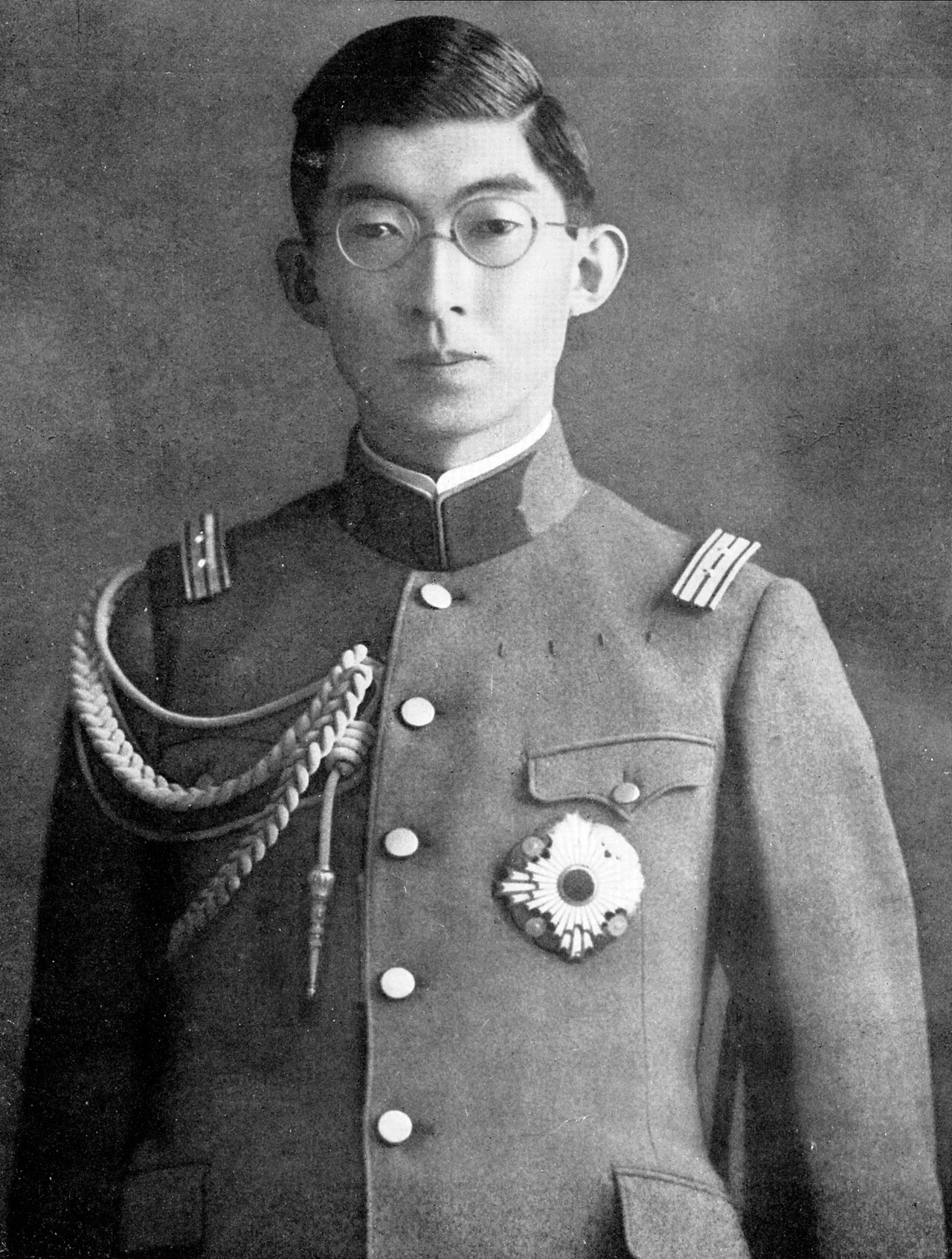
Prince Yasuhito Chichibu (1902-1953) was the second son of Emperor Taishō and a younger brother of Emperor Hirohito, serving as a general in the Imperial Japanese Army. In 1925 he travelled to Britain to study at Magdalen College, Oxford, where King George V decorated him with the Grand Cross of the Royal Victorian Order. He represented Japan at the coronation of King George VI in 1937 and later visited Nuremberg, where he met Hitler. After the assassination of prime minister Inukai Tsuyoshi in 1932, he had many violent arguments with his brother, Emperor Hirohito, about the suspension of the constitution and the implementation of direct imperial rule. During the war, he was involved in combat operations, and was sent to Manchukuo, where he attended lectures by the director of unit 731 on bacteriological warfare. After the war, he served as honorary president of both the Japan-British Society and the Swedish Society of Japan.
Sources:
Princess Chichibu. The Silver Drum: A Japanese Imperial Memoir. Global Books Ltd. (UK) (May 1996). Trans. Dorothy Britton https://www.kunaicho.go.jp/en/learn/about/history/history12.html

Harris & Ewing photographer, Public domain, via Wikimedia Commons
Sources:
Hermann Baerwald Obituary; Dr Salo Adler

Bosch, Carl
Carl Bosch (1874–1940) was a German industrial chemist who joined BASF to undertake the task of transferring Fritz Haber's laboratory process for synthesising ammonia into viable industrial productionrequiring more than 20,000 experiments, including an exhaustive search for effective catalysts among metals and their compounds. Bosch later became president of BASF when it merged into the IG Farben cartel. In 1931 he was awarded the Nobel Prize in Chemistry jointly with Friedrich Bergius, in recognition of their development of chemical high-pressure methods. A critic of many Nazi policies, including anti-semitism, Bosch was gradually relieved of his high positions, and fell into depression and alcoholism. He died in Heidelberg.
Sources:

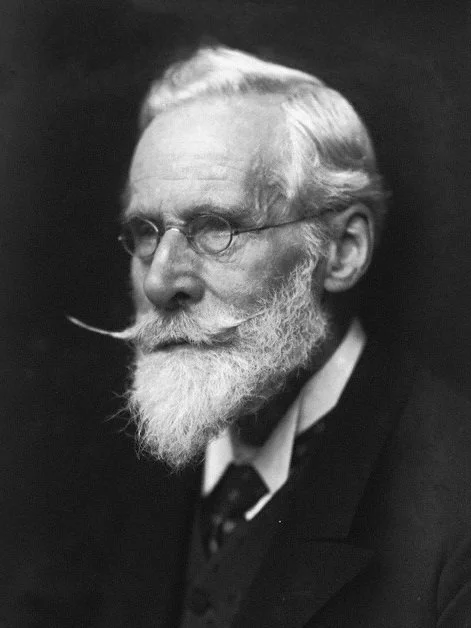
Crookes, Sir William
Sir William Crookes (1832–1919) was a British chemist and physicist noted for his discovery of the element thallium and for his cathode-ray studies, fundamental in the development of atomic physics. In the book, he is noted for his warnings of the depletion of nitrogenenous fertizilers leading to mass starvation, a warning which he gave to the British Association and encouraged the development of synthetic fertilisers. He also discovered the principle behind the Crookes radiometer, which converts light radiation into rotary motion, and was knighted in 1897.
Doihara, General Kenji
Sources:
Britannica:https://www.britannica.com/biography/William-Crookes
Kenji Doihara (1883–1948)was born in Okayama in 1883, and went on to excel at military academy, and became became a specialist on China. After the First World War, promoted to major in Peking, Doihara built an extensive espionage network using prostitutes, opium dens and networks of Chinese business men and politicians which sold large concessions of Manchuria into Japanese possesion. Doihara engineered the Manchurian Incident in 1931 to provide the pretext for military invasion and convinced Pu Yi to be the head of the Manchu puppet state. As described in the book, throughout the 1930s Doihara continued his activities across China, maintaining networks of agents within the Nationalist government, exploiting opium trafficking and prostitution as instruments of control, and working to detach northern Chinese provinces from Nationalist authority. After the war, he stood trial before the International Military Tribunal and was convicted on more accounts than any other defendant. He was hung in 1948
Sources:
Warfare History Network https://warfarehistorynetwork.com/article/kenji-doihara-japanese-general-and-convicted-war-criminal/

Sources:
Public domain, via Wikimedia Commons
Sources:
Public domain, via Wikimedia Commons

Donovan, Bill
William J Donovan (1883–1959) was known as the "Father of American Intelligence", leading the OSS through its formative years. He was trained as a lawyer, and fought in France during WW1, during which time he was promoted to colonel. During the interwar years, Donovan served as a U.S. district attorney and assistant attorney general. His legal expertise and global political connections led President Franklin D. Roosevelt to task him with drafting plans for a centralized intelligence service. In 1941, he was appointed Coordinator of Information, and by 1942, he became the chief of the new Office of Strategic Services (OSS). Under his leadership as a brigadier general, the OSS conducted global espionage, counterpropaganda, and covert operations, particularly across Europe. Although he was a primary advocate for a permanent peacetime intelligence agency, he declined a role in the CIA upon its creation in 1947. He concluded his public service as the U.S. Ambassador to Thailand from 1953 to 1954.
Sources:
Britannica https://www.britannica.com/biography/William-J-Donovan
Duisberg, Carl
Carl Duisberg (1861-1935) was a chemist and industrialist who cofounded IG Farben as the CEO of Bayer. In 1903, following a trip to America, after being inspired by Standard Oil as a conglomerate, he proposed the merger of the German dye factories, which eventually culminated in the formation of IG Farbenindustrie, completed in two stages in 1916 and 1925. In the book, his role in helping finance the capital requirements which fertiliser production required is something he was strongly involved in as the CEO of Bayer. In the years following World War I, he assumed major responsibilities in public life, championing German science and student welfare. Generations of students between the two World Wars called him the "Father of Students."

Sources:
Deutshe Biografie https://cdg-carlduisberg.de/en/about-carl-duisberg/
Sources:
Library of Congress, Washington, D.C. (digital file no. LC-DIG-hec-18832)

Dulles, Allen
Allen W. Dulles (1893–1969) served as director of the Central Intelligence Agency during its formative years of growth from 1953 to 1961. he practised law in New York before being recruited into intelligence work during World War II by Colonel William J. Donovan for the Office of Strategic Services. From 1942 to 1945 he served as chief of the OSS office in Bern, Switzerland, playing a notable role in securing the surrender of German troops in northern Italy.After the CIA was established, he served as deputy director before being appointed director by President Eisenhower in 1953. Dulles supported maintaining the Japanese Monarchy when reconstructing Japan and supported and helped form the Liberal Democratic party, a new pro-Western, anti-communist led by many former ultranationalists involved in the former regime. However, the downing of a U-2 spy plane over the Soviet Union in 1960 and the disastrous Bay of Pigs invasion of Cuba in 1961 led to his resignation.
Sources:
Britannica https://www.britannica.com/biography/Allen-W-Dulles Cia. Gov docs on Dulles - eg https://www.cia.gov/readingroom/docs/CIA-RDP75-00001R000100040116-5.pdf
Einstein, Albert
Albert Einstein (1879-1955) was born in Ulm Germany, but moved to Switzerland at the age of 16. Unable to find a teaching post after gaining his diploma in 1901, he accepted a position as technical assistant in the Swiss Patent Office, where he produced much of his remarkable early work. His special theory of relativity stemmed from an attempt to reconcile the laws of mechanics with those of the electromagnetic field, and in 1916 he published his landmark paper on the general theory of relativity. Him and Haber were close friends, despite conflicting views, as Einstein was a pacifict and Haber supported Germany in WW1 as a nationalist. Einstein moved to America in 1933 and renounced his German citizenship. After World War II he was a leading figure in the World Government Movement and collaborated in establishing the Hebrew University of Jerusalem. He died in Princeton, New Jersey
Sources:
Nobel Prize Biographical https://www.nobelprize.org/prizes/physics/1921/einstein/biographical/

Sources:
US Library of Congress Prints and PhotographsD.C. 20540 USA http://hdl.loc.gov/loc.pnp/pp.print
Sources:
לשכת העיתונות הממשלתית, Public domain, via Wikimedia Commons

Epstein, Israel
Israel Epstein (1915–2005) was a Polish-born Chinese journalist and one of few foreign born citizens to become a member of the Chinese Communist party. Born in Warsaw to Jewish parents, he arrived in China at the age of two and settled in Tianjin. He began his journalism career at fifteen, writing for the Peking and Tientsin Times, before going on to cover the Japanese invasion of China for the United Press and other Western news agencies. In 1938 he joined the China Defense League, established by Soong Ching-ling, Sun Yat-sen's widow, and reported from the front lines during the Second Sino-Japanese War, as well as continuing to help Jews who lived in China during the war. He became personally acquainted with Edgar Snow and was among the first to read the manuscript of Red Star Over China before publication. He became a Chinese citizen in 1957 and died in Beijing in 2005.
Sources:
Pan, Guang (2019) A Study of Jewish Refugees in China(1933–1945): History, Theories and the Chinese Pattern, Singapore: Springer, pp. 63–83,
Erzberger, Vice Chancellor Matthias
Vice Chancellor Matthias Erzberger (1875 - 1921) was a politician who was killed by far-right former naval officers, showing the emergence of fascism between Japan and Germany. Elected to the Reichstag in 1903, he became a prominent expert on financial and colonial policy, notably exposing colonial scandals in 1905–06.He was instrumental in the 1917 peace resolution and later signed the 1918 armistice at Compiègne, an act that earned him the permanent enmity of the radical right. As Finance Minister and Vice-Chancellor in 1919, he secured the acceptance of the Treaty of Versailles to prevent national dissolution and implemented a massive reorganization of Germany’s tax and railway systems. He was shot by 2 former naval officers, an operation meticulously planned by the Germanic Order.
Sources:
Deutsch Biografie https://www.deutsche-biographie.de/sfz13699.html#ndbcontent

Sources:
Bundesarchiv, Bild 146-1989-072-16
Sources:
Archiv für Kunst und Geschichte, Berlin
https://www.britannica.com/biography/Erich-von-Falkenhayn#/media/1/200750/10528
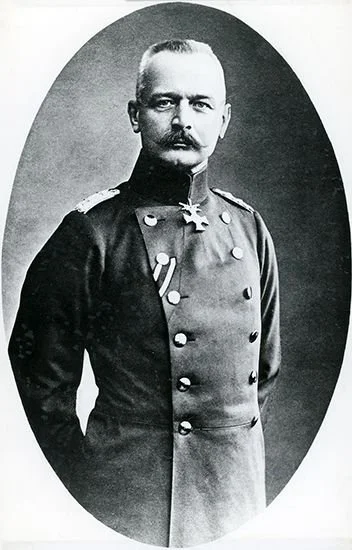
Falkenhayn, General Erich von
Erich von Falkenhayn (1861-1922) was a Prussian military officer who rose to become Chief of the German General Staff during World War I, after having served in China for 16 years. He was appointed Prussian Minister of War in 1913 and, on November 3, 1914, assumed command of the German land forces following the failure at the Marne, and oversaw the use of chemical weapons at Ypres in 1915, as mentioned in the book. Convinced early on that a decisive victory against the coalition of enemy powers was no longer achievable, he called as early as November 1914 for a separate peace with Russia in order to concentrate forces in the West. He was dismissed in 1916, after the battle of the Somme.
Sources:
Deutsche Biografie: https://www.deutsche-biographie.de/sfz15537.html#ndbcontent
Gehlen, Reinhard
Reinhard Gehlen (1902–1979) was a German military intelligence officer whose career spanned the Third Reich and the early decades of the Cold War. During World War II, Gehlen served as a Major General in the Wehrmacht, heading the Foreign Armies East department, which gathered and analyzed intelligence on Soviet military capabilities. His meticulous collection of data on the Red Army would prove to be his most valuable asset. As Germany's defeat became inevitable, Gehlen made a calculated gamble: he microfilmed vast quantities of his intelligence files, buried them in the Austrian Alps, and surrendered to U.S. forces in 1945. He correctly anticipated that the wartime alliance between the West and the Soviet Union would soon collapse, and that his expertise would be indispensable to the Americans. His bet paid off and the U.S. military, and later the CIA, enlisted Gehlen to rebuild a West German intelligence network using many of his former officers — some with deeply troubling Nazi pasts. In 1956, this network was formalized as the Bundesnachrichtendienst (BND), West Germany's foreign intelligence service, with Gehlen serving as its first president until his retirement in 1968.
Sources:
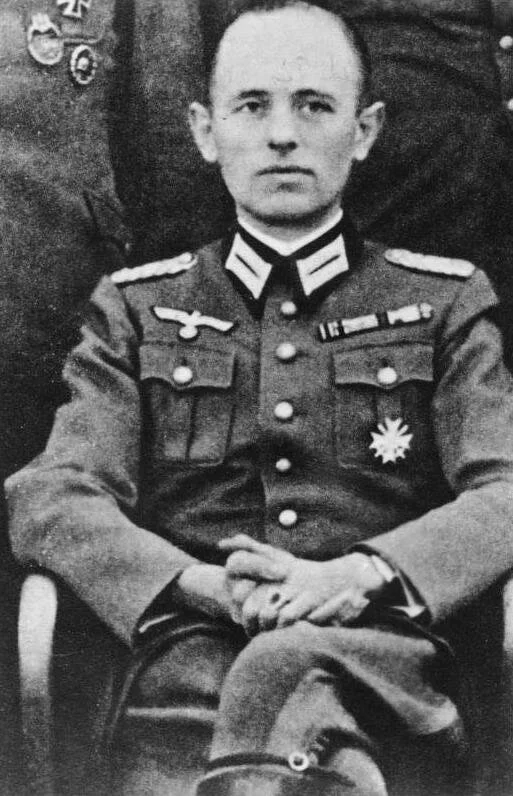
Sources:
Bundesarchiv, Bild 183-27237-0001 / CC-BY-SA 3.0, CC BY-SA 3.0 DE <https://creativecommons.org/licenses/by-sa/3.0/de/deed.en>, via Wikimedia Commons
Sources:
Maximillian Goldschmidt: Beth Hatefutsoth Photo Archive, Public domain, via Wikimedia Commons

Goldschmidts
Another family in very senior positions in the Philanthropin School, the Goldschmidts were the founders of the BNP Paribas (World's 8th Largest Bank). In the 20th Century, Adolphe and Maximillian Rothschild shut down the families Frankfurt branchm, and Maximillian founded the Goldschmidt-Rothschild & Co. in Berlin, but the firm struggled through the Weimar-era economic chaos and was transferred to state ownership in 1932. Their Assets were seized by the Nazi's, upon which they fled to London and continued their English branch, Goldsmith.
Sources:
Rothschild Archive https://www.rothschildarchive.org/collections/research_guides/provenance_research Frankfurt person Lexicon https://frankfurter-personenlexikon.de/node/2407
Haber, Fritz
Fritz Haber (1868–1934) was a German-Jewish chemist born in Breslau (now Wrocław) who developed the Haber Bosch process, a method for the direct synthesis of ammonia from hydrogen and nitrogen, for which he was awarded the Nobel Prize in 1919. As mentioned in the book, he also developed Chlorine gas, and personally oversaw its first use in Ypres in 1915, and considered himself a German nationalist. His wife Clara Immerwahr (mentioned below), killed herself in response to his developments, saying they were a "perversion of science". He believed the development of chemical weapons would cause the Entente to quickly capitulate, and therefore save lives, but proved to be incorrect, with over 1 million casualties reported from chemical weapons. He was a houseguest of Ernst's in Tokyo. He was forced to flee Germany in 1934 to Switzerland, where he died the same year.
Sources:
Dunikowska, Magda and Turko Ludwik https://arxiv.org/pdf/1112.0949

Sources:
See page for author, Public domain, via Wikimedia Commons
Sources:
Jewish Womens Archive, Public Domain

Haber/Immerwahr, Clara
Clara Immerwahr - Haber (1870–1915) was a German chemist and physicist who became the first woman awarded a doctorate in physical chemistry at a German university. She married Fritz Haber in 1901, and helped contribute to his research on ammonia synthesis as well as his textbook on thermodynamics, both of which she was overlooked for. With the outbreak of WW1, Haber dedicated himself to developing poison gas warfare for the German military. Appalled, Immerwahr publicly condemned his work as "a perversion of the ideals of science". As described in the book, after the slaughter at Ypres, Haber had a party in his honour, at which the couple argued, resulting in her committing suicide with Haber's pistol. Their son Hermann heard the shot and alerted his father, who nevertheless left the next morning for the Eastern Front. Her reputation has linked moral responsibility to science
Sources:
Jewish womens Archive - https://jwa.org/encyclopedia/article/immerwahr-clara#pid-11485
Hahn, Mickey
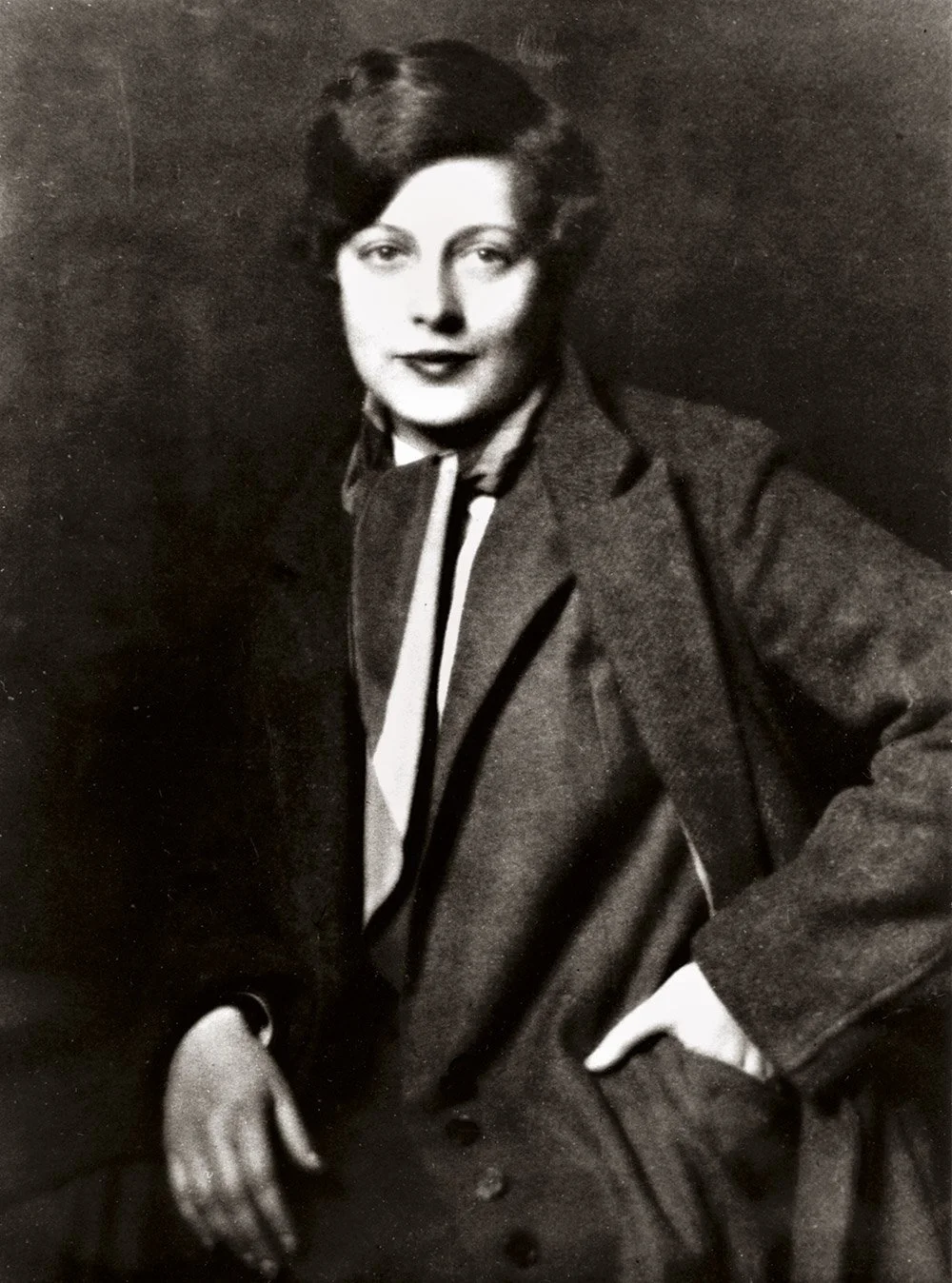
Emily "Mickey" Hahn (1905–1997) was a journalist and feminist who grew up in a German-Jewish family in the US.In 1935, Hahn moved to Shanghai as a correspondent for The New Yorker, a role she held for nearly 70 years. During the Japanese occupation, she remained in Hong Kong, using a false Eurasian identity to smuggle food to her future husband, Major Charles Boxer, while he was a prisoner of war. She gave birth to their daughter a week before the attack on Pearl Harbour, and was deeply involved in much of China's intellectual circles, meeting both Zhou Enlai and Mao Zedong before they held any power. She published 54 books in her lifetime, and more than 10 about China.
Sources:
Emily Hahn Estate
Sources:
Basch, [...] / Opdracht Anefo, CC BY-SA 3.0 NL <https://creativecommons.org/licenses/by-sa/3.0/nl/deed.en>, via Wikimedia Commons

Hahn, Otto
Otto Hahn (1879–1968) discovered several radioactive elements, among them radiothorium and protactinium. As the book says, he was in Ypres when gas was used for the first time and discussed with Haber how the use of gas opposed the Geneva convention. In 1907 with physicist Lise Meitnerand Fritz Strassmann, Hahn demonstrated in 1938 that uranium nuclei could be split. Profoundly troubled by the destructive applications of his discovery, Hahn became a vocal opponent of nuclear armament in the postwar years. He returned to Germany after World War II and led the Max Planck Society for the Advancement of Science until his death in 1968
Sources:
Nobel Prize biographical https://www.nobelprize.org/prizes/chemistry/1944/hahn/biographical/
Hanssen, Hermann
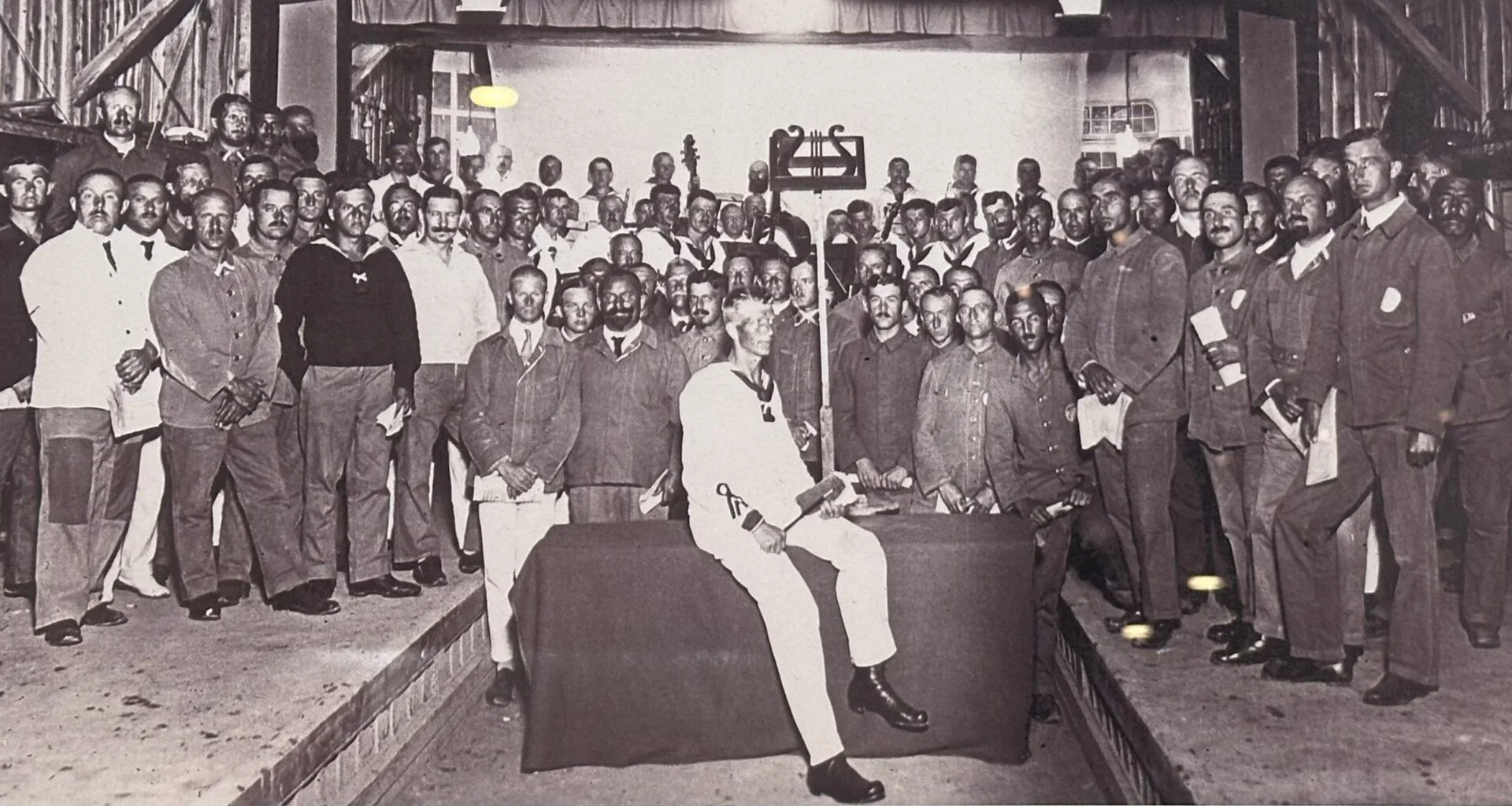
Hermann Richard Hansen (1883–1927) was a naval officer captured at Tsingtao prisoner of war from November 21, 1914, in the Osaka camp then April 6, 1917, transferred to the Bando camp; Conductor of the "Tokushima Orchestra" and the "MAK Orchestra" in Tokushima and Bando, he conducted Beethoven's Ninth Symphony for the first time in Japan on June 1, 1918, in Bando. He was released early on August 26, 1919, to participate in the plebiscite in North Schleswig and returned home on the steamer Mitau.
Sources:
Tsingtau biography under H http://www.tsingtau.info/
Sources:
Bandō Prison Camp
Sources:
Huffman Modern Japan: An Encyclopedia of History, Culture, and Nationalism. Routledge. P74

Hara, Prime Minister Takashi
Prime Minister Hara Takashi (1856–1921) was a Japanese statesman born into a samurai family who assisted Itō Hirobumi in founding the Rikken Seiyūkai, one of Japan's earliest political parties, and he devoted the remainder of his life to building its foundations, earning recognition as a key architect of party government in Japan. In 1918, following rice riots and the collapse of the Terauchi cabinet, he was appointed prime minister. Widely celebrated as the "commoner prime minister" for his modest lifestyle his overriding ambition throughout remained the expansion of political party power. On November 4, 1921, he was assassinated by "Patriot" (see below), a right-wing youth at Tokyo train station.
Sources:
Huffman Modern Japan: An Encyclopedia of History, Culture, and Nationalism. Routledge. P74
Heifetz, Jascha
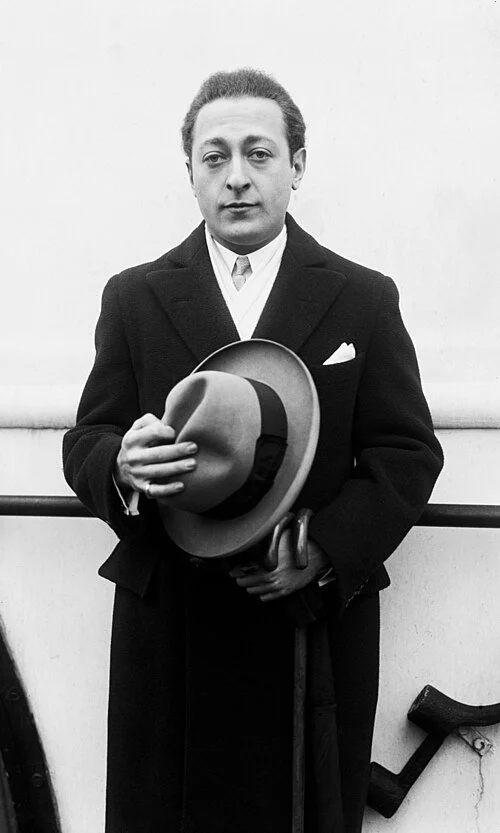
Jascha Heifetz (1901–1987) was a Russian-born American violinist who studied violin from age three and performing Mendelssohn's Violin Concerto at six. At nine he entered the St. Petersburg Conservatory under the renowned teacher Leopold Auer. His first Berlin appearance in 1912 so impressed conductor Arthur Nikisch that he was invited to perform Tchaikovsky's Violin Concerto with the Berlin Philharmonic, and he was touring Europe by the age of twelve. Fleeing the Russian Revolution in 1917 via Siberia, he subsequently toured extensively across Europe, the Orient, the Middle East, and was the only artist to not cancel his performance after the 1923 Tokyo Earthquake, and staging charity concerts to support victims. He died in Los Angeles in December 1987.
Sources:
Bain News Service, publisher, Public domain, via Wikimedia Commons
Sources:
Publisher: Encyclopædia Britannica https://www.britannica.com/biography/Gustav-Hertz#/media/1/263890/11574
Hertz, Gustav
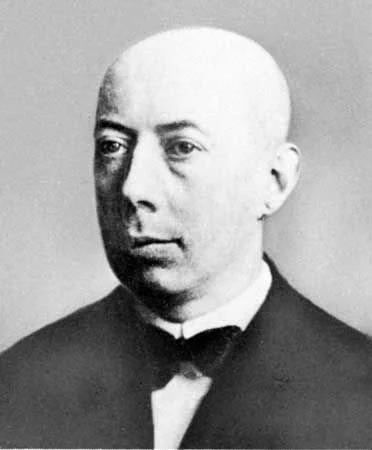
Gustav Hertz (1887–1975) was a German physicist and 1925 Nobel prize winner who designed experiments to prove quantum theory. As mentioned in the book, he was also on the Haber's unit which tested chemical weapons and was there for their first use at Ypres. Before the end of the 2nd World War, he defected to the Soviet Union where he continued his research, before moving back to East Germany from 1954. The research he did in the Soviet Union helped develop their nuclear program.
Sources:
EBSCO https://www.ebsco.com/research-starters/history/gustav-hertz
Hirohito, Emperor
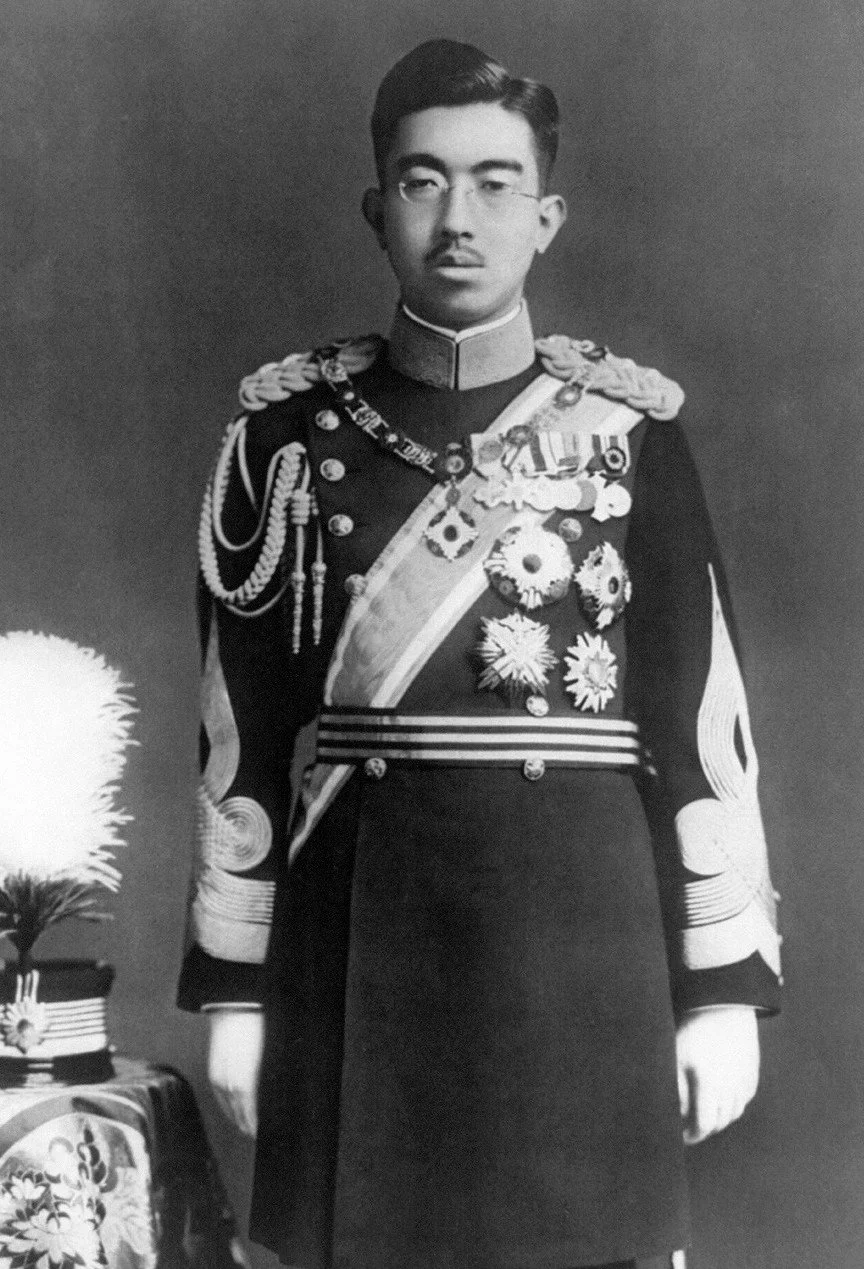
Hirohito (1901–1989) was Emperor of Japan from 1926 until his death, making him the longest-reigning monarch in Japanese history. Born in Tokyo as the son of the Taishō emperor and grandson of the Meiji emperor, and during his education he developed a lifelong interest in marine biology on which he later published several books. In 1921 he became the first Japanese crown prince to travel abroad, visiting Europe. His reign, designated Shōwa, meaning "Bright Peace" is disagreed about by historians, with different levels of blame assigned to him for his role in Japanese military expansion, with interpretations ranging from reluctant figurehead to active participant in expansionist planning. What is undisputed is that in August 1945, with Japan facing defeat, Hirohito intervened decisively in favour of surrender, making an unprecedented national radio broadcast on August 15 to announce Japan's acceptance of Allied terms. On January 1, 1946, he made a second historic broadcast repudiating the traditional quasi-divine status of Japan's emperors.Under Japan's postwar constitution, his powers were severely curtailed and he became a constitutional monarch and "symbol of the state." He died in 1989 and was succeeded by his son Akihito.
Sources:

Sources:
United States Library of Congress's Prints and Photographs division
under the digital ID cph.3a40859
Sources:
Portraits of Modern Japanese Historical Figures https://www.ndl.go.jp/portrait/e/datas/235
Inoue, Junnosuke
Junnosuke Inoue(1869-1932) was an important banker who served as the head of the Bank of Japan from 1919, then going on to serve as Finance Minister across 2 separate terms, from 1923-1927 and 1929-1931, then going on to head one of the main 2 political parties of Japan. He was assasinated, in the same event in which Dan Takuma was killed, by far right ultra-nationalists who thought national reform could be achieved only through violent confrontation with what he saw as the forces of evil: pro-Western liberal politicians and zaibatsu business interests, in an event called the League of Blood Incident.
Sources:
Portraits of Modern Japanese Historical Figures https://www.ndl.go.jp/portrait/e/datas/235
Kashii, Kojima
Kojima Kashii was the driver of Yamashita, the Japanese commander who oversaw the hiding of billions worth of loot stolen during the Japanese Imperial conquests. Allegedly tortured and coerced in 1945, Kashii showed the American officers several vaults which he had helped cover, an operation overseen by Ed Landsdale, as mentioned in the book.
Sources:
Seagrave and Seagrave, (2000) Gold Warriors: America's Secret Recovery of Yamashita's Gold
No photo available

Sources:
Portraits of Modern Japanese Historical Figures https://www.ndl.go.jp/portrait/e/datas/578
Kishi, Nobusuke
Kishi Nobusuke (1896–1987) acted as the vice-minister of Japanese-occupied Manchuria's industry, and played a pivotal role in industrial development and the colonial economy. He implemented state-led economic planning to transform Manchuria into a military-industrial powerhouse before being called to return to Japan in 1940, eventually joining Tōjō Hideki’s wartime cabinet. Despite his high-ranking role, his later opposition to Tōjō's "war at all costs" policy contributed to the cabinet's 1944 collapse. Although imprisoned by Allied authorities after 1945, he was released without trial in 1948. He helped to establish the Liberal-Democratic Party in 1955 which as previously described was partially funded by the CIA. He was Prime minister between 1957-60, changing the constition to allow for more aggressive defense spending.
Sources:
Britannica https://www.britannica.com/biography/Kishi-Nobusuke
Kodama, Yoshio
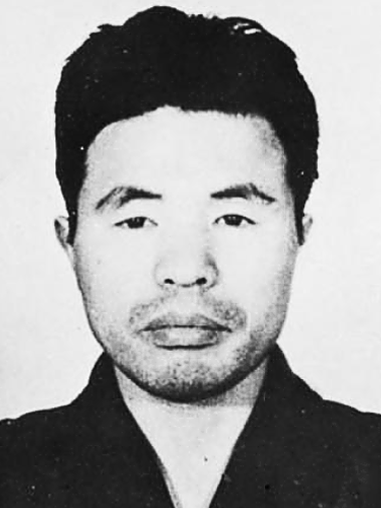
Kodama Yoshio (1911-1984) spent a lifetime promoting right-wing causes and people. During the 1930s, Kodama spent six years in jail for his ultranationalist activities, including founding the Independence Youth Society (Dokuritsu Seinensha) and plotting to assassinate Prime Minister Saitō Makoto. He was active in the puppet state of Manchukuo and in China during the World War II years, first in intelligence and fact-finding work for the Foreign Ministry, later in securing military materials for the naval air force through his own Kodama Agency. His agency made a fortune in the latter tasks, largely by securing looted supplies cheaply. He was imprisoned as a suspected war criminal, but these charges were dropped as he agreed to supply American intelligence, and stayed in positions of power, continuing to bankroll extremist politicians throughout his life.
Sources:
Huffman Modern Japan: An Encyclopedia of History, Culture, and Nationalism. Routledge. P117
Sources:
Public domain, via Wikimedia Commons

Sources:
Unknown Author, Public domain, via Wikimedia Commons
Konoe, Viscount Hidemaro
Hidemaro Konoe (1898–1973) was a Japanese conductor and composer who, alongside Kosaku Yamada, laid the foundation for Western classical music in Japan. Born in Tokyo as the second son of Duke Atsumaro Konoe, his rebellious temperament led him toward Western music at a time when it was virtually unexplored in Japan and was a friend of Ernst Baerwald's. Hiring the Berlin Philharmonic at his own expense, Konoe made his conducting debut to considerable acclaim and went on to appear with the orchestra many times as a guest conductor.
Returning to Japan in 1924, he co-founded Japan's first professional orchestra and later established the New Symphony Orchestra. He conducted over 90 orchestras worldwide, and towards the end of World War II is said to have used his orchestra as cover to help Jewish musicians escape persecution in Paris and Warsaw.
Sources:
Konoe Music Research Institute https://www.hidemarokonoye.com/about-us
Krupp, Gustav
Gustav Krupp (1870-1950) was a lawyer by profession who worked in the Prussian Foreign Office before meeting Bertha Krupp, sole heiress to the Krupp industrial empire, and assumed chairmanship of the company's supervisory board in 1909, holding it until the end of 1943. Under his leadership, the company expanded dramatically before World War I, with total sales rising from 91.4 million marks in 1902/03 to 463.4 million marks in 1912/13. During World War I, Krupp became the backbone of German armaments production, with output increasing sixfold by the war's third year. Germany's defeat plunged the company into severe difficulty, forcing costly conversion away from armaments into locomotives.After 1933, Krupp was integrated into the rearmament policies of the Third Reich, with Hitler designating the company a "model Nazi enterprise." Krupp saw himself as a trustee of the company and guardian of its tradition, resisting widespread layoffs out of social responsibility to his workforce. After the war he was indicted as a major war criminal at Nuremberg, but suffered strokes that left him unfit to stand trial. He died in January 1950.
Sources:
Deutsche Biografie: https://www.deutsche-biographie.de/sfz46431.html#ndbcontent

Sources:
Bain, Public domain, via Wikimedia Commons

Sources:
US Air Force, Public domain, via Wikimedia Commons
Lansdale, Ed
Edward Lansdale (1908–1987) served in the OSS during WW2 as an intelligence officer, until he was later sent to the Philippines, where he joined the torture sessions of Major Kojima Kashii "as an observer and participant", from which information was required which led to the retrieval of Yamashita's Gold, looted by the Japanese Imperial Army. As described in the book, the bullion recovered was sent to funding anti-communist movements throughout the world. Lansdale rose to fame in the early 1950s by helping Philippine's defeat the communist Hukbalahap rebellion, and was involved in the Vietnam war, employing strategies of psychological warfare, propaganda, and grassroots political reform. He retired in 1968.
Sources:
Konoe Music Research Institute Cecil B Curry, Edward Lansdale: The Unquiet American 1988 Spartacus educational https://spartacus-educational.com/COLDlansdale.htms
Seagrave and Seagrave, (2000) Gold Warriors: America's Secret Recovery of Yamashita's Gold
Lehman Family
The Lehman family was another prominent Jewish banker family, which founded the Lehman Brother's bank, which collapsed in 2008. The family bank was founded in 1850's Germany and until 1924 it was exclusively run by subsequent generations of the Lehman family, until 1924, when external partners were brought in. It's relations to the Philanphropic also ran deep as the Direktor Karl Herzberg was a partner of Lehman Brothers as well as the consul to the Mexican Republic.
Sources:
Harvard Business School: https://www.library.hbs.edu/special-collections-and-archives/exhibits/lehman/lehman-brothers-family-partners

Sources:
Mayer Lehman: Herbert H. Lehman Papers, Rare Book and Manuscript Library, Columbia University Public domain, via Wikimedia Commons

Sources:
Unknown Author, Public domain, via Wikimedia Commons
LeMay, General Curtis
Curtis E. LeMay (1906–1990) was a U.S. Air Force officer who's tactic of urbicide in Japan led to the loss of hundreds of thousands of lives from his effective bombing campaigns. After commanding B-29 operations in India and China, he took over the 21st Bomber Command in the Mariana Islands in January 1945. In this role he devised and executed the low-altitude incendiary bombing campaign that devastated Tokyo and numerous other Japanese cities, a strategy designed to force Japanese surrender ahead of the planned Allied ground invasion scheduled for later that year. LeMay ordered the bombing of 67 Japanese cities with chemicals such as napalm, as he knew the urban areas were made of wood, making residential areas burn down quickly. After the war LeMay commanded US air forces in Europe, directing the Berlin Airlift of 1948 and became becoming chief of staff of the Air Force in 1961, a position he held until his retirement in 1965.
Sources:
Britannica https://www.britannica.com/biography/Curtis-E-LeMay
Luxemburg, Rosa
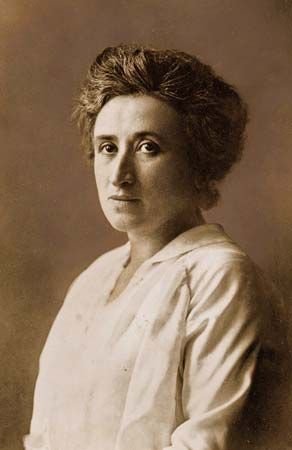
Rosa Luxemburg (1871–1919) was a Polish-born German revolutionary and political theorist who played a central role in the radical socialist movement of the early twentieth century. The youngest child of a lower middle-class Jewish family in Russian-ruled Poland, she became involved in underground political activities while still in high school, emigrating to Zürich in 1889 to avoid imprisonment. There she earned a doctorate in law and political economy and co-founded the Polish Social Democratic Party. When World War I broke out, she co-founded the Spartacus League to oppose the war and agitate for revolution, spending much of the conflict in prison. Released by the German Revolution of November 1918, she and Karl Liebknecht co-founded the German Communist Party in December of that year. On January 15, 1919, both were arrested and murdered by Freikorps paramilitaries in Berlin, during the Spartacist uprising.
Sources:
Britannica https://www.britannica.com/biography/Rosa-Luxemburg
Sources:
Unknown Author, Public domain, via Wikimedia Commons

Sources:
The Harry S. Truman Library/NARA
Publisher: Encyclopædia Britannica https://www.britannica.com/biography/Douglas-MacArthur#/media/1/353669/12745
MacArthur, General Douglas
Douglas MacArthur (1881–1964) was the Supreme Commander of Occupied Japan and a preeminant American General. After distinguished service in France during World War I, where he rose to brigadier general, he was recalled to active duty in 1941, where he led defense in the Philippines before being ordered to Australia to command the Southwest Pacific Theater. His "island-hopping" strategy in New Guinea and the Admiralties effectively neutralized Japanese strongholds. On September 2, 1945, he presided over the Japanese surrender ceremony in Tokyo Bay, following which he became Supreme Commander. MacArthur acted as an autocratic reformer of Japan as he directed the drafting of a liberal constitution and implemented sweeping changes in land redistribution, women’s rights, and education. He led Allied forces after the outbreak of the Korean War, but was relieved of the position due to insubordination.
Sources:
Britannica https://www.britannica.com/biography/Douglas-MacArthur
Mao Zedong
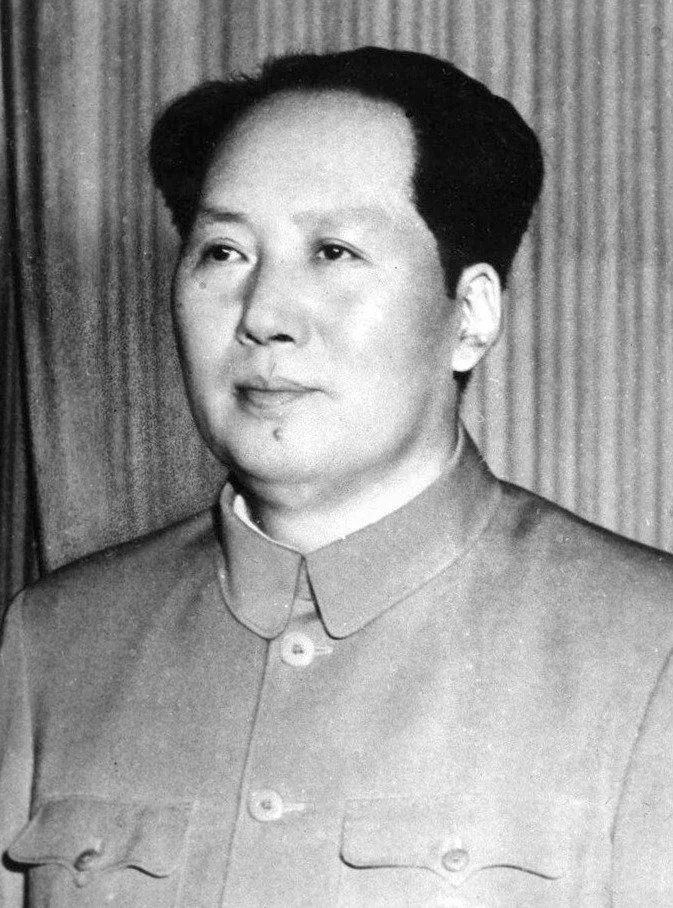
Mao Zedong (1893–1976) was bornin Shaoshan, Hunan province, to an affluent peasant family, he became a founding member of the Chinese Communist Party (CCP) in 1921 .Mao emerged as the undisputed leader of the CCP after the Long March in 1934–35, when they fought the Nationalist government. He founded the People’s Republic of China in 1949, serving as its chairman until 1959 and remaining party chairman until his death. The 3 main campaigns which formed Mao's rule were the Great Leap Forward (1958–60) aimed at rapid industrialization but which resulted in a catastrophic famine, the Cultural Revolution (1966–76) to crush "bourgeois" elements, which lead to huge social upheaval and a solidification of his cult of personality. Finally, the the Third Front campaign (1960s-1980) aimed to develop industrial and military facilities in the countries interior to prepare for any future war and develop new areas. He died in 1976 of a heart attack
Sources:
Sources:
Chen Zhengqing (1917–1966), Public domain, via Wikimedia Commons

Sources:
Naruto City web https://www.city.naruto.lg.jp/contents/daiku/english/about.html
Matsue, Colonel Toyohisa
Colonel Toyohisa Matsue (1872–1956) was the leader of the Bandō prison camp, brought in to uphold Japan's treatment of POW's as exemplary, after the Russo-Japanese war. He was born in Aizu region, a samurai stronghold, which had fought against, and been defeated by, the imperial government. This is said to have affected his thinking about mercy and kindness, and was well respected by the German troops.
Mayer-Waldeck, Governor
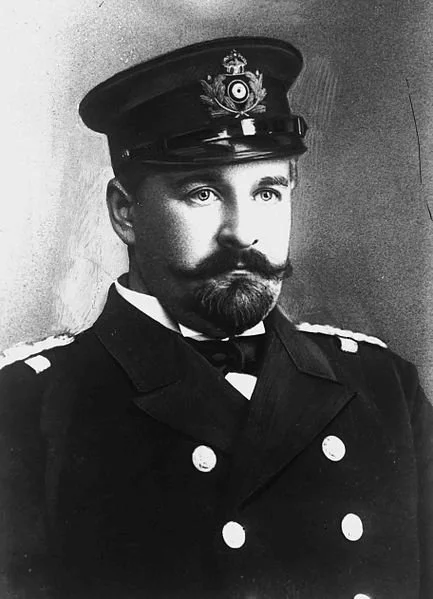
Alfred Meyer-Waldeck (1864 – 1928) was a German naval officer born in St. Petersburg, entering the navy at 20 years old, and was eventually appointed as chief of staff in Tsingtau from December 1908, acting as deputy governor in 1909–10, before being appointed full governor in 1911 as successor to Governor Truppel. When Japan declared war on Germany on August 23, 1914, Meyer-Waldeck organised and led the defence of Tsingtau against the Japanese siege. Following the city's fall on November 7, 1914, he was taken to Japan as a prisoner of war, where he remained until 1920. He was not held in Bandō prison camp with the others, instead being moved to a camp at Narashino. He retired after coming back from Japan.
Sources:
BildNr 018-0081-26 aus dem Bildbestand der Deutschen Kolonialgesellschaft in der Universitätsbibliothek Frankfurt am Main

Sources:
Uchida Kuichi, Public domain, via Wikimedia Commons
Meiji, Emperor
Emperor Meiji (1852–1912) was the emperor of Japan from 1867 to 1912, during whose reign Japan was dramatically transformed from a feudal country into one of the great powers of the modern world. The beginning of his reign coincided with the end of the Togugawa Shogunate and executive authority being granted back to the emperor . Unlike his father, he supported the growing consensus on the need for modernization along Western lines, following Japan's resumption of contact with other nations after 250 years of cultural and economic isolation. In the book he is often brought up in the context of the Satsuma Rebellion, where his forces slaughtered up to 15,000 disaffected Samurai. He orderd the end of the feudal system, new education, the opening of the Diet and the Meiji constitution, as well as leading the Sino-Japanese War and the Russo-Japanese War, and in 1910 the annexation of Korea, from which the Dark Ocean School was based.
Sources:
Brittanica https://www.britannica.com/biography/Meiji
Mendellsohn, Moses
Moses Mendellsohn (1729-1786) was an incredibly influential Jewish Philosopher and Enlightenment thinker who was central to the Jewish Reform movement. He was central to working on the improvement of Jewish rights in Germany, as a moderate figure who preached for religious toleration and the German Jews embracing modern life, from their previously isolated state, whilst still preserving their heritage, known as Haskalah.
Sources:
Deutche Biografie: https://www.deutsche-biographie.de/sfz70694.html#ndbcontent


Sources:
Courtesy Universitätsbibliothek Leipzig, Portrait Collection 33/85
Publisher: Encyclopædia Britannica https://www.britannica.com/biography/Moses-Mendelssohn#/media/1/374802/225027
Sources:
The_passing_of_Korea.djvu: Homer Hulbert.Ryuch at en.wikisourcederivative work: — billinghurst sDrewth, Public domain, via Wikimedia Commons
Min, Queen
Queen Min (1851–1895) was the queen consort of Korea's Yi Dynasty, who was killed by the Japanese soldiers to consolidate their grip over Korea. Born Ja-young Min, she married King Kojong in 1866 at the age of fifteen, chosen specifically because her family's poverty was thought to make her politically harmless. 1873 and becoming the de facto ruler of Korea given her husband's weak and dissolute character. Governing at a moment of intense imperial pressure from Japan, China, and Russia, Min controlled Korea through a series of crises, signing trade treaties with Western powers while resisting outright annexation. When Japan emerged victorious from the Sino-Japanese War in 1895 and moved to consolidate control over Korea, Min looked for support and cooperation from the Russians. In a plot code-named "Fox Hunt," Japanese troops in came forward to prevent further murders of court women. She was stabbed repeatedly and her body burned with kerosene in a nearby wood. None of those responsible were convicted.
Miyamoto, Musashi
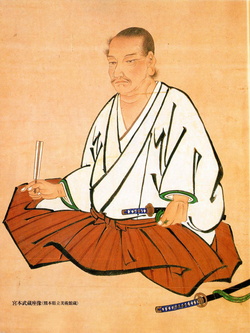
Musashi Miyamoto (1584-1645) was a famous Japanese samurai who was seen as an inspirational figure to many of Japan's far right ultranationalists, as described in the book. Musashi began his career as a fighter early in life when, at age 13, he killed a man, and went onto become a ronin (masterclass samurai) after losing a major battle. Musashi claimed to have fought in more than 60 individual sword fights, many of which were to the death and all of which he won. According to legend, Musashi wrote his famous book on war strategy on his deathbed, and the book was seriously studied by executives in the West in order to better understand Japanese management techniques and strategies after its 1974 translation .
Sources:
Britannica https://www.britannica.com/biography/Miyamoto-Musashi-Japanese-soldier-artist
Sources:
Kumamoto Prefectural Museum of Art, http://www.1-em.net/sampo/Gorinnosyo/index.htm Public domain, via Wikimedia Commons
Sources:
See page for author, Public domain, via Wikimedia Commons Japanese book "Pictorial History of Modern Japan Vol.8" published by Sanseido.
Nakaoka Kon'ichi, 'Patriot'
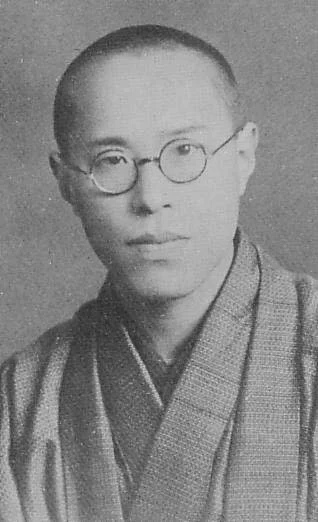
Patriot' Nakaoka Kon'ichi(1903-1980) was an ultranationalist railway switchman who assasinated prime minister Hara Takashi at Tokyo Station on November 4, 1921. His motives were the 'narrow interests of the Seiyukai' (the friends of constitutional government) and thought they favoured the Zaibatsu (conglomerates) over normal people. He only served 13 years of his life sentence, and then moved to Manchukuo to continue his job as a railway switchman.
Sources:
https://www.ndl.go.jp/modern/e/cha3/description10.html Pure Spirits: Imperial Japanese Justice and
Right-Wing Terrorists, 1878–1936
Danny ORBACH
Nomura, General Kichisaburō
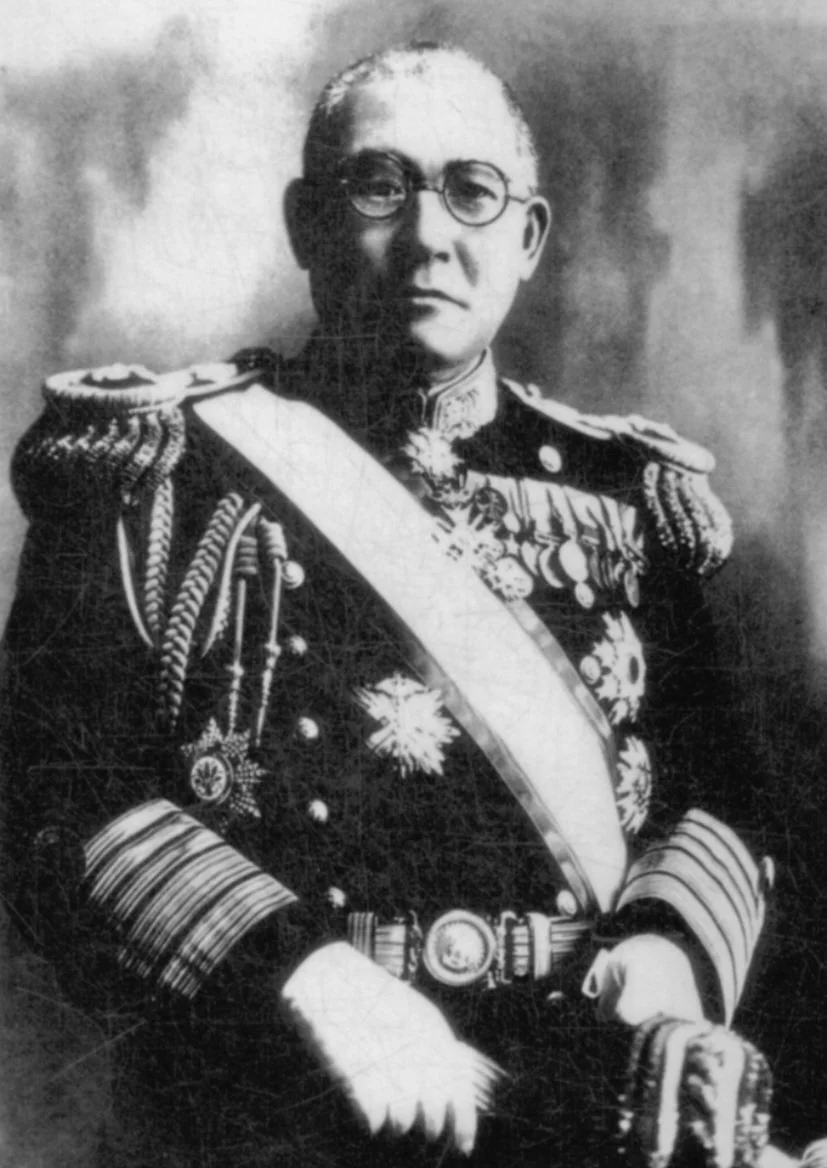
Kichisaburō Nomura (1877–1964) was an admiral in the Imperial Japanese Navy and Japan's ambassador to the United States at the time of the attack on Pearl Harbor. During World War I he served as naval attaché to the United States, and later participated in the Versailles Peace Conference and the Washington Naval Conference. In April 1932, a Korean independence activist threw a bomb at Japanese dignitaries in Shanghai's Hongkou Park, blinding Nomura in one eye. Appointed ambassador to Washington in November 1940, he spent much of 1941 negotiating with Secretary of State Cordell Hull to prevent war, repeatedly urging his government to offer meaningful concessions, and Hull later credited Nomura for sincerely trying to prevent the conflict.
Sources:
photographer is unknown, Public domain, via Wikimedia Commons

Sources:
Circa 1917 / CC-BY-SA 3.0, CC BY-SA 3.0 DE <https://creativecommons.org/licenses/by-sa/3.0/de/deed.en>, via Wikimedia Commons
Oppenheim, Max von
Max von Oppenheim (1860-1946) was a spy, diplomat, archaeologist and Orientalist, who served as an intermediary between Western and Eastern interests. Born to the prominent Oppenheim family (mentioned above), he forsake a career in finance to go work in Cairo, where he was an informant on Egyptian political activities for Germany. He founded the Intelligence Bueeau for the East, an office who's purpose was to spread propaganda to Muslim target groups. His greatest archaeological achievement was the discovery and excavation of Tell Halaf in southeastern Anatolia, revealing the remains of an ancient Aramaic city with impressive statuary and stone reliefs
Sources:
Max von Oppenheim foundation https://max-von-oppenheim.foundation/max-von-oppenheim/biography/
Oppenheim Family
The Oppenheim family founded the Sal. Oppenheim bank, (founded by Salomon Oppenheim in the 18th century), and it went on be the largest privately owned investment/banking house in Europe until its sale in 2009. The family were also on the Philanthropin board of directors and closely linked to the Rothschild Family. The Nazi era proved deeply traumatic: in 1931 Simon Alfred brought in non-Jewish partner Robert Pferdmenges, and by May 1938 the bank's name had been changed to Bankhaus Robert Pferdmenges & Co. Baron Friedrich Carl von Oppenheim aided Jewish emigration during the Nazi era, later earning recognition as Righteous Among the Nations. See Max Von Oppenheim for more
Sources:

Sources:
Template:CJoseph Weber, Public domain, via Wikimedia Commons
Sources:
See page for author, Public domain, via Wikimedia Commons
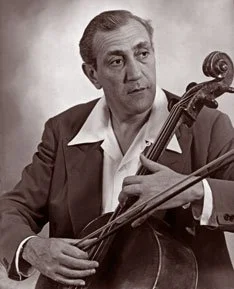
Piatigorsky, Gregor
Gregor Piatigorsky (1903–1976) was one of the pre-eminent string players of the twentieth century, born in Ukraine and widely regarded as the world's premier touring cello virtuoso during the 1940s and early 1950sHis talent emerged early: he began playing at age seven, entered the Moscow Conservatory at nine, and by fifteen was principal cellist of the Bolshoi Opera. Fleeing the Russian Revolution in 1921, he studied with Julius Klengel in Leipzig and at twenty-one became principal cellist of the Berlin Philharmonic under Furtwängler. He left in 1929 to pursue a solo career. In 1923, he toured Japan and had at party hosted for him at Ernst's house. Marrying Jacqueline Rothschild, he moved to America in 1939, becoming a US citizen in 1942 and finally settled in Los Angeles in 1950, where he taught alongside Heifetz at USC.
Pu Yi
Puyi (1906–1967) was the last emperor of China's Qing dynasty who ascended to the Manchu throne at the age of just three following the death of his uncle until 1912, when the Chinese Revolution forced his abdication. He was permitted to remain living in the palace in Beijing, and adopted the Western given name Henry. In 1924 he secretly left Beijing to reside in the Japanese concession at Tianjin. In 1932 he was installed as president of the Japanese-controlled state of Manchukuo in Manchuria, becoming its emperor from 1934 to 1945 under the reign title Kangde. At the end of World War II he was taken prisoner by the Russians and returned to China in 1950 to stand trial as a war criminal. Pardoned in 1959, he settled in Beijing, working first in a botanical garden's mechanical repair shop before becoming a researcher at the Chinese People's Political Consultative Conference.
Sources:
Britannica: https://www.britannica.com/biography/Puyi

Sources:
George Grantham Bain Collection/ Library of Congress, Washington, D.C. (LC-DIG-ggbain-21677)

Sources:
Photograph by Arnold Genthe, 1918.
Courtesy of the Library of Congress (LC-G4085- 0398 P&P).
Rockefeller, JD
John D. Rockefeller (1839-1937) was an American industrialist and philanthropist who founded the Standard Oil Company in 1870 and, through a combination of strategic acquisitions, preferential railroad rates, and ruthless price-cutting, built an empire that by 1879 controlled 90 percent of the nation's oil-refining capacity. As previously mentioned, his practises inspired the consolidation of IG Farben into one conglomerate, with the book quoting his famous words "competition is a sin", His methods made him one of the most controversial figures of the age, leading to the Sherman Antitrust Act of 1890. In 1911 the Supreme Court ordered the dissolution of the Standard Oil trust into thirty-eight separate companies. His fortune peaked at an estimated $900 million in 1913, but over his lifetime he gave $500 million to charitable causes, and remained a devoted Christian
Romana, Santy
Severino Garcia Diaz 'Santy' Romana was a Filipino American who was also directly involved with the extraction of the loot recovered from the Phillipines. He used torture and other methods of force to help uncover the treasure, and profited massively off their discovery. According to Seagrave and Seagrave, he used aliases all over the world and set up various companies all over the world with the personal fortune he ammased from the vaults. He died in 1974, and some of his largest black gold accounts transferred into the possesion of Ed Landsdale.
Sources:
Seagrave and Seagrave, (2000) Gold Warriors: America's Secret Recovery of Yamashita's Gold
No photo available
Sources:
(Original photographer of work is unknown due to company closing in the 1960's. NPG would have added photograper's name if known), Public domain, via Wikimedia Commons
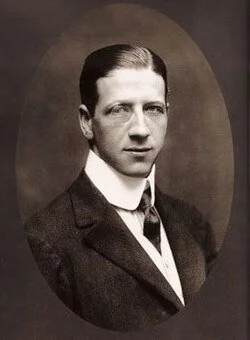
Rothschild, Baron Armand von
Baron James Armand Edmond de Rothschild was a politician and philanthropist born in 1878. He was educated in Paris and went to university at Trinity College, Cambridge. He was on the Board of Directors for the Philanthropic School, where Ernst attended, as well as many other members of the Rothschild family. Armand fought in First World War for the "Jewish Legion", and served as the Parliamentary Secretary for the Ministry of Supply during the Second World War. He passed away in 1957.
Rothschild Family
The most famous of the European Banking Dynasties, the Rothschilds were very involved in all matter of finance across the 20th century and were involved in the Philanthropin School as part of the board of Directors. The family faced enormous upheaval during the World Wars — the French business was controlled by the government during the war years and only returned to the family in 1945, with many French family members spending the war in exile in New York. See Armand Von Rothschild above for a character profile on a prominent Rothschild who was relevant to Ernst's life.

Sources:
Rothschild family archive: https://www.rothschildarchive.org/family/

Sources:
Portraits of Modern Japanese Historical Figures. https://www.ndl.go.jp/portrait/e/datas/85
Saigo Takamori
Saigo Takamori (1828-1877) was a leader in the Imperial overthrow of the Togugawa Shogunate as a loyalist to the emperor and he commanded the troops that seized control of the imperial palace from the shogunate, helping lead the Meiji Restoration. He opened a military school in his native Kagoshima that drew to it disaffected former samurai (class distinctions had been abolished in 1871). In 1877 some of his disciples attacked a government arsenal, and he found himself the unwilling head of a rebellion. It lasted for six months and resulted in some 12,000 dead on both sides, including Saigō himself. He is regarded as a tragic hero by the Japanese.
Sources:
Britannica https://www.britannica.com/summary/Saigo-Takamori
Sasakawa Ryoichi
Ryoichi Sasakawa (1899–1995) was a Class A War Criminal and far-right politican and businessman who was involved with the Japanese Army and the occupation of Manchuria, who went on to become a billionare and philanthropist after the war. He inherited his father's fortune at age 23, and invested in mining and rice, which made him incredibly rich. He joined the Patriotic People's Party (PPP), a right-wing party which was involved in several political assasinations. He was involved in Manchurian industrial exploitation, and was an admirer of Mussolini who he flew to Italy to meet, calling him the "perfect fascist and dictator". After the war, he was arrested as a Class A war criminal, but was released in 1948, and went on to becoming a billionaire from boat racing, using his money to contribute to various charitable funds as well as conservative politicians.
Sources:
Cia.web https://www.cia.gov/readingroom/docs/SASAKWA%2C%20RYOICHI_0002.pdf

Sources:
MaedhrosTheW, CC0, via Wikimedia Commons

Sources:
Unknown photographer, David Sasson and his sons, mid-19th century, Public domain, via Wikimedia Commons
Sassoon Family
The Sassoons were a wealthy Baghdadi Jewish Dynasty who were known as the "Rothschilds of the East". They were involved in the Philanthropic School of Frankfurt, as financiers, as well as being majorly being involved in Western interests in the Orient. See more on Victor Sasson
Sources:
Jewish Encyclopedia https://www.jewishencyclopedia.com/articles/13218-sassoon
Sasson, Victor
Sir Victor Sassoon (1881–1961) was a British entrepeneur, and heir to his families commerical dynasty (see Sassons above). Originally from Baghdad via Bombay, Sassoon relocated his empire to Shanghai in the 1920s to escape high taxes and political unrest in India. He transformed the Shanghai skyline, becoming the city’s top realtor through landmarks like the Cathay Hotel. During the Japanese occupation of Manchuria, as described in the book (although Ernst had left a couple of days before the assault) and subsequent attacks on Shanghai, he used his wealth and influence to stall Japanese efforts to seize the International Settlement. He famously funded soup kitchens and schools, and donated Embankment House to shelter approximately 20,000 European Jewish refugees fleeing the Holocaust. Despite being labeled a "traitor" by Japanese authorities for his pro-British defiance, he remained in the "front row" of the conflict until 1941. Before the Communist takeover in 1949, he sold his holdings and moved to the Bahamas, where he continued his business dealings until his death.
Sources:
HistoryNet Staff (3/30/2026) Wartime Shanghai: A Tycoon Triumphs Over the Emporer https://historynet.com/wartime-shanghai-a-tycoon-triumphs-over-the-emporer/?f

Sources:
דוד טאוב, CC BY-SA 4.0 <https://creativecommons.org/licenses/by-sa/4.0>, via Wikimedia Commons

Sources:
Arnold Schönberg Center - Wien
Seligman Family
The Seligman family entered the 20th century as one of America's great banking dynasties, but their influence gradually waned. They were also strongly linked to the Philanthopin school. In the early 20th century the firm helped finance the construction of the Panama Canal. During World War I the firm held major positions in all Allied loan syndicates and invested heavily in US government bonds, as well as being major partners for the Treasury in getting bonds sold in Germany.
Sources:
The Last partnerships : inside the great Wall Street money dynasties "Our Crowd" / Charles R. Geisst.
Sirota, Augustine
Augustine was the sister of Jascha Horenstein, a friend of Leo's and a famous composer, who was introduced to Leo when her brother invited her to hear Leo play at a concert when they were both studying at the University of Vienna. After this, she began to study piano with Sirota, and eventually the two were engaged in an affair, as Augustine was still married. She eventually divorced her husband and married Leo, and both her and Leo became naturalised Austrian citizens by the 1920s, giving birth to their daughter Beate Sirota-Gordon in 1923. She moved to Japan permanently with Leo in 1930, and the US in 1946. They are buried together at Ferncliff Cemetary, New York.
Sources:
Yamamoto, Takashi (2019). Leo Sirota: The Pianist Who Loved Japan. Translated by Bantock, Gavin; Inukai, Takao. Kashiwa: First Servant Books. ISBN 978-4-9910037-1-4.

Sources:
The Sirata family -Ainley, M. (2021) 'Leo Sirota', The Piano Files, 4 May. Available at: https://www.thepianofiles.com/leo-sirota/
Sources:
Arnold Schönberg Center - Wien
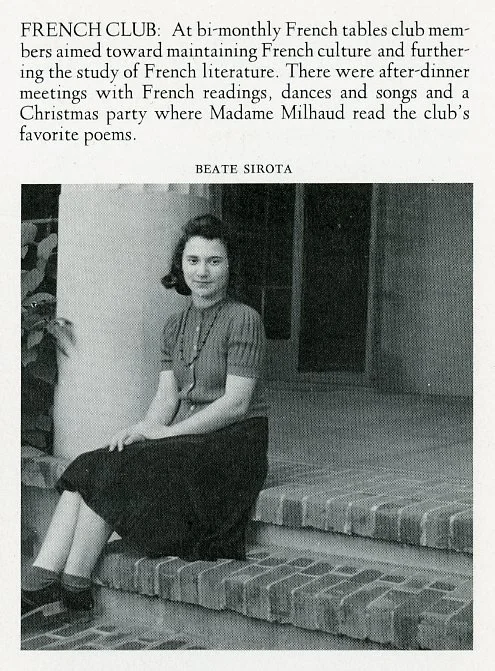
Sirota-Gordon, Beate
Beate Sirota-Gordon, the daughter of Leo and Augustine, was born in Vienna in 1923, and moved with her family to Japan in 1929. She attended the German school in Japan for 6 years, before her parents decided to pull her out as the school was "too Nazi". She then transferred to the American School in Japan with Kurt Baerwald, before leaving to study at University in California in 1939, becoming a US citizen in 1945. During the war, she worked in the Office of War Infomation, and when the war was over, she was the first civilian woman to arrive in Japan. She went on to work as a translator for Douglas MacArthur, and later helped draft the civil rights section of the current Japanese constitution, being instrumental in ensuring legal equality between men and women. She went on to work in performing arts, being a prominent figure in Japanese-American art culture, and died in 2012 in Manhattan.
Sources:
Gottesfeld, J. (2020) 'The Impossible Life of Beate Sirota Gordon', PB Daily, Jewish Book Council, 17 June. Available at: https://www.jewishbookcouncil.org/pb-daily/the-impossible-life-of-beate-sirota-gordon (Accessed: 7 March 2026).
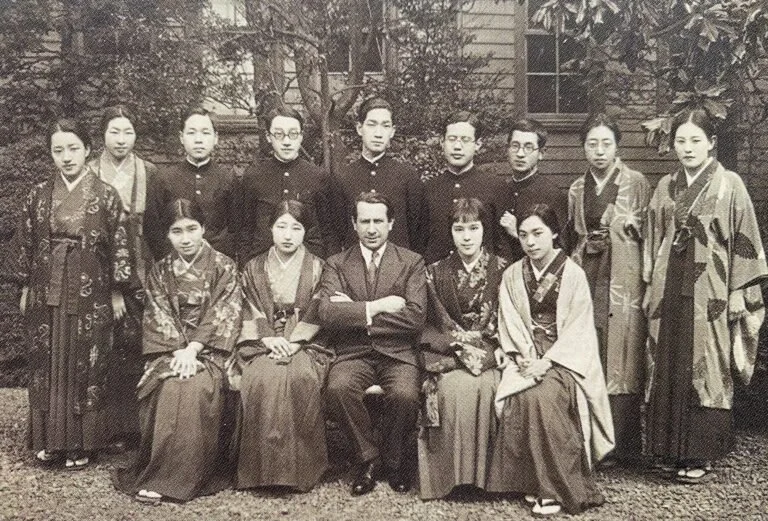
Sirota, Leo
Leo Sirota, a Ukrainan Jew who first performed at 10 years old in Berlin, was a world famous pianist and a friend of Ernst Baerwald's. He studied at the University of Vienna, where he became very famous, before became a Professor of the Piano at the Japanese Imperial Academy of Music, and stayed in Japan with his family until 1946. After the Tripartite pact between Japan, Italy and Germany, he was persecuted and became stateless, being barred from work and removed from the Imperial academy of Music. After the end of the war, he moved to the US, where he continued to work successfully as a pianist until his death in 1965.
Sources:
Yamamoto, Takashi (2019). Leo Sirota: The Pianist Who Loved Japan. Translated by Bantock, Gavin; Inukai, Takao. Kashiwa: First Servant Books. ISBN 978-4-9910037-1-4.
Sources:
Ainley, M. (2021) 'Leo Sirota', The Piano Files, 4 May. Available at: https://www.thepianofiles.com/leo-sirota/

Sources:
Bundesarchiv, Bild 183-1985-1003-020 / CC-BY-SA 3.0, CC BY-SA 3.0 DE <https://creativecommons.org/licenses/by-sa/3.0/de/deed.en>, via Wikimedia Commons
Richard Sorge
Sorge was born in Berlin and served in WW1 on both fronts. Influenced by the war, he joined the Communist party of Germany, and studied political science in Hamburg, and went on to live in Moscow as a member of the Communist party of the Soviet Union, and was sent to spy in China in 1930, and later to Japan in 1933, where he was allegedly trusted. He joined the Nazi party in 1934, and enjoyed the trust of the German embassy, often gaining access to secret files, and is confimed to have given the date of the start of the German invasion of Russia several weeks in advance. He also informed Stalin that the Japanese had no ambitions to attack Russia by mid 1941, allowing far East troops to be deployed in the West. He was arrested in 1941 by the Japanese police, and executed in 1943. He was recognised by the USSR as one of their spies and a national hero in 1964.

Sun Yat-Sen
Sun Yat-Sen (1866–1925) is widely regarded as the founder of the Chinese Republic after the overthrow of the Qing Dynasty. He grew up in an area of China which was most exposed to foreign influence, and in 1879, he moved to Hawaii, received a Western education and converted to Christianity, returning to China in 1894 to devote his life to revolutionary policies. In 1905 he founded the Tongmenghu and after a series of failed uprisings, revolution finally succeeded in October 1911, and Sun assumed the presidency of a provisional Chinese republic on January 1, 1912. He subsequently founded the Kuomintang, or Nationalist Party, in August 1912. Facing the betrayal of his republican ideals by the general Yuan Shikai, he was forced into exile once more before eventually establishing a rival government in south China in 1921.In 1923 he secured Soviet military assistance to strengthen the Kuomintang, reorganising it along Soviet Communist Party lines and was linked to Bayer as they supplied Sun's forces with painkillers and amphetamines. He died in Beijing in March 1925, before achieving the national unification he sought.
Sources:
EBSCO - https://www.ebsco.com/research-starters/history/sun-yat-sen
Sources:
上海波尔照相馆, Public domain, via Wikimedia Commons
Sources:
宮内省(Imperial Household Agency), Public domain, via Wikimedia Commons
Taisho, Emperor (Yoshihito)
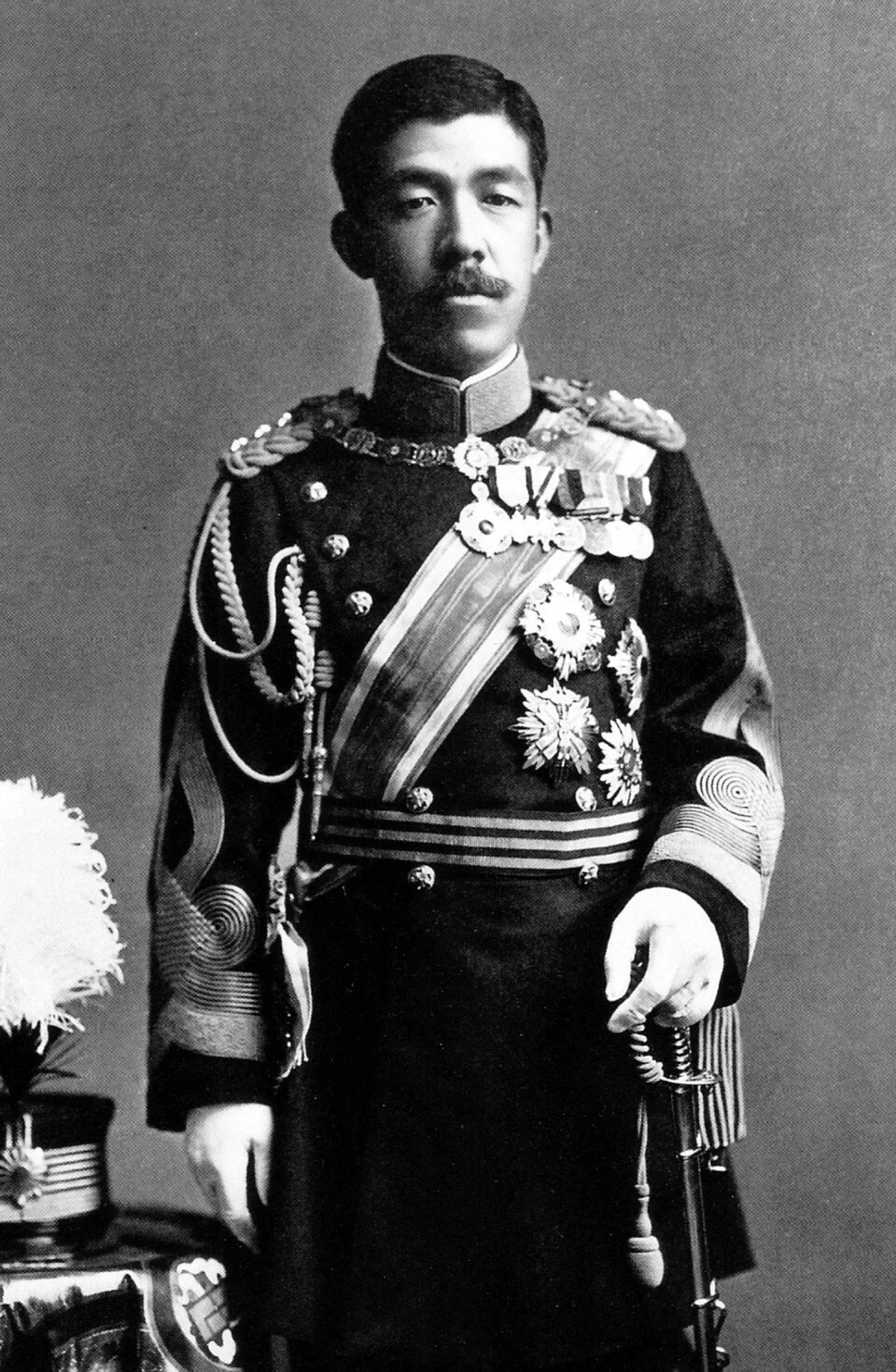
Emperor Taishō (1879-1926) was the son of Emperor Meiji and Emperor of Japan between 1912 to 1926, continuing the modernisation of the Japanese economy and society which had started under his father's reign. He had been sickly as a child and played little political role, but his rule was a time of great cooperation in international affairs, with policies being preferable to Western nations. He was a stong believer in democracy, but in his later years he became mentally deranged and his power was undermined, and his son, Emperor Hirohito, was appointed Prince regent in 1921.

Takahashi, Baron
Takahashi Korekiyo was a statesman and financier from Meiji Era to the pre-war days of Showa. He studied in the US, learning English, and he rose to become the vice-president of the Bank of Japan by 1892. He secured US loans for Japan during the Russo-Japanese war of 1904, and was appointed finance minister in 1913, by Prime Minister Gonnohyoe and later reappointed by Hara. He became Prime Minister temporarily after the assisanation of Hara, but was forced to resign due to conflict in his party. He then continued to serve roles in the cabinet until 1936, when he was assasinated in an attempted coup-de-etat, led by a far-right army faction, who opposed Meiji-Era reforms. He was seen as one of the last major figures in government who stood up to the far-right factions.
Sources:
Smethurst, Richard J. (2007). From Foot Soldier to Finance Minister: Takahashi Korekiyo, Japan's Keynes.
Sources:
Kinsei Meishi Shashin vol.1 Public domain, via Wikimedia Commons

Takuma, Dan
Dan Takuma was the manager of the giant Mitsui zaibatsu (conglomerate), the greatest of the family-owned combines in pre-World War II Japan. It managed a wide portfolio but focused on trading, banking, mining and synethetic fertilisers and dyes, giving it strong ties to Bayer.Dan graduated from MIT, and was an important member of Japan’s business elite, Dan was assassinated by right-wing nationalists who regarded him as a symbol of the evil power of high finance in government.

Tokugawa, Marquis Yorisada
Yorisada Tokugawa (1892-1954) was the heir of the Tokugawa house, which ruled Japan for over 250 years. He was a prominent music patron and heard about the Bandō concert and visited the camp several months later for an encore performance. Appointed to the House of Peers in 1939, he was subsequently elected to the House of Councillors in the first election of 1947, where he served in a range of prominent roles including Chairman of the Committee on Foreign Affairs and director of Diplomatic Relations of the Policy Research Council of the Liberal Party.

Sources:
The Modern Review. May 1938, Public domain, via Wikimedia Commons
Toyama Mitsuru
Toyama Mitsuru was born to a poor samurai family in 1855. As a youth, he joined an association of disaffected samurai in Fukuoka, and joined the Saga rebellion in 1874, three years before the final Satsuma Rebellion. He then helped found the Genyosha - the Dark Ocean Society, who were heavily involved in yakuza activities and aimed to increase Japanese Militaty expansion. He continued this goal through his life, and supported the Japanese Invasion of Manchuria as well as Sun Yat-Sen campaign against the Qing dynasty. As an ultranationalist, he helped get extremist figures into government and was involved in the murder of liberal politicians, as mentioned in the book. After the murder of Premier Baron Inukai in May, 1932, the Black Dragon head-quarters were raided and Toyama was arrested, but was not charged. He died in 1944 of illness.

Uchida, Ryohei
Ryohei Uchida(1873-1937) was a Japanese ultranationalist U political activist and founder of the Kokuryūkai (Amur River Society). A native of Fukuoka Prefecture, he became a disciple of Tōyama Mitsuru, joined the Gen’yōsha (Black Sea Society), formed the Kokuryūkai in 1901, and actively supported Japanese expansion on the Asian continent (dai-Ajia shugi). Regarding Russia as the main threat to Japan, he wrote and published a series of virulently anti-Russian pamphlets and books, visited Vladivostok to gather intelligence on Russian activities in Asia, and advocated Japanese control of the Amur River Basin as a buffer against the Russian advance. In 1906, he obtained an appointment to the staff of Japan’s resident-general in Korea, and used his position there to help foment the unrest that resulted in Japan’s annexation of Korea in 1910. Thereafter, he primarily attacked the political Left in Japan and published a huge volume of propaganda
Sources:
Huffman Modern Japan: An Encyclopedia of History, Culture, and Nationalism. Routledge. P275
Sources:
Unknown Author, Uchida Ryohei, Public domain, via Wikimedia Commons
Sources:
Unknown Author Public domain, via Wikimedia Commons
Wang Ching-Wei
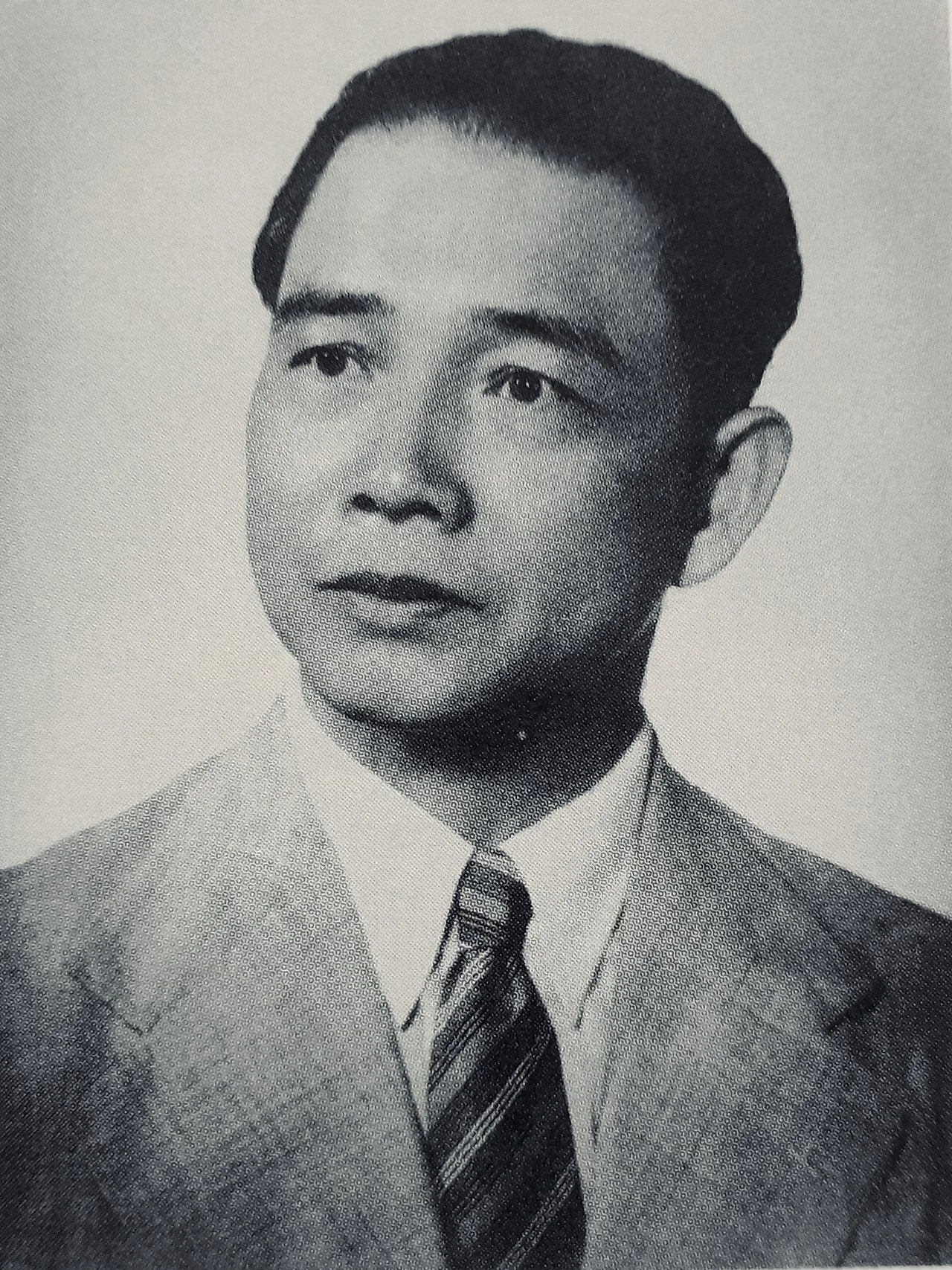
Wang Ching-Wei (1883–1944) was a revolutionary who is most famous for his betrayal of the Kuomintang and acting as the figure head for the Japanese puppet state fom Nanjing. Wang studied Western thought in Japan, where he joined Sun Yat-sen's revolutionary United League and quickly established himself as one of its leading political writers. To revitalise the revolutionary movement, he attempted to assassinate the imperial regent but was captured and sentenced to life immprisonment. The Republican Revolution of 1911 freed him as a hero after the fall of the Qing Dynasty. Wang became one of Sun Yat-sen's closest associates, serving as his personal assistant for seven years and rising to senior positions in the Nationalist Party. After Sun's death in 1925, he became chairman of the national government, but had a continual power struggle with Chiang Kai-Sek. Wang led a rival left-wing regime in Wuhan before purging the communists in 1927 and gradually reconciling with Chiang by 1932, becoming president of the Nationalist Party while Chiang retained military supremacy. When war with Japan broke out in 1937, Wang broke with the Nationalist government, flying to Hanoi in 1938, and in 1940he became head of a Japanese-backed regime. He died in Nagoya in 1944.
Sources:
Britannica https://www.britannica.com/biography/Wang-Ching-wei

Warburg, Felix
Felix Warburg was a German-American financier and banker. Born in 1871, he was the grandson of the founder of the bank M. M. Warburg & Co, who had founded it alongside Charlotte Oppenheim. He moved to Frankfurt to study, then to New York for his wife. He was the son-in-law of the most important Jewish philanthropist of the time, Jacob Schiff and became inspired by his philanthropy, eventually gaining the title "the king of American Jewry". He was also involved in the Philanthropic School in Frankfurt and a close friend of Paul Baerwald, Karl Baerwald in the book, Ernst's brother. During the war he gave huge sums of money to causes helping Jews but was a strong opponent of Zionism, instead supporting increased immigration of Jews to the US. He died in 1937.
Sources:
Photograph by Pirie MacDonald, 1913.
Courtesy of the Library of Congress (LC-USZ62-75145).
Sources:
Publisher: Encyclopædia Britannica
https://www.britannica.com/biography/William-II-emperor-of-Germany#/media/1/644086/158327
Wilhelm II, Kaiser
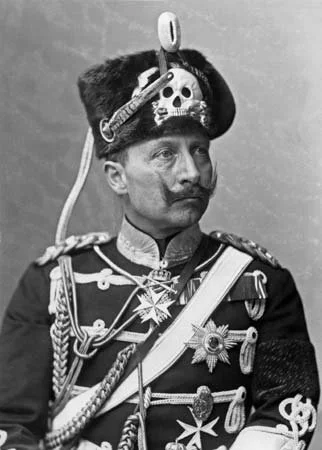
Kaiser Wilhelm II (1859-1941) succeded his father as the Kaiser of Germany in 1888, and forced Bismarck's resignation in 1890, changing his careful systems of alliances into a more aggressive foreign policy. From 1897, he encouraged Admiral Tirpitz to strengthen the German fleet and challenged France’s position in Morocco . He sided with Austria-Hungary in the crisis with Serbia (1914), and in World War I he encouraged the grandiose war aims of the generals and politicians. After Germanys defeat he fled to the Netherlands, ending the German monarchy. He asked Hitler if he would reinstate him as Kaiser in 1940.
Sources:
Britannica https://www.britannica.com/summary/William-II-emperor-of-Germany

Willoughby, Colonel Charles
Colonel Charles Willoughby (1892–1972) was a German-born American military officer who became one of Douglas Arthurs most trusted intelligence chiefs. Born in Heidelberg, he immigrated to the U.S. in 1910, enlisting in the Army before earning his degree.In 1941, Willoughby became MacArthur’s Chief of Intelligence (G2), a role he maintained through the Southwest Pacific campaigns of World War II and remained with MacArthur during the occupation of Japan, as well as during the Korean War. He founded the Allied Intelligence Bureau, before retiring in 1951.
Sources:
National Archives and Records Administration, Public domain, via Wikimedia Commons
Sources:
National Photo Company, Public domain, via Wikimedia Commons
Woods, Cyrus
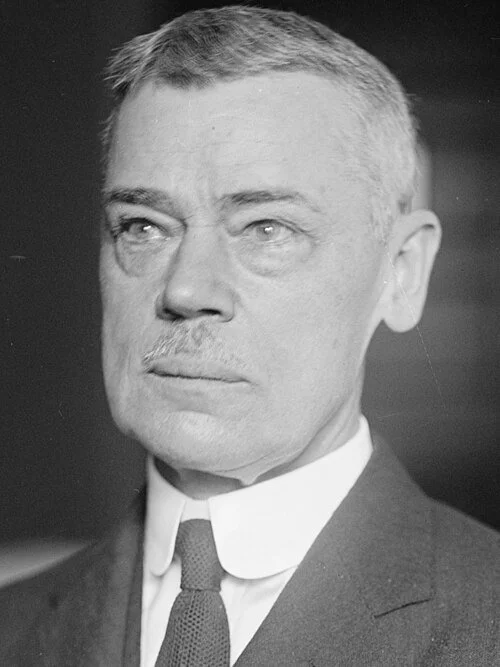
Cyrus Woods (1861-1938) was an American who served as the American Ambassador to Japan between 1923-1924.Woods’ political ascent began in 1900 with his election to the Pennsylvania State Senate, where he served two terms and eventually became President Pro Tempore. His diplomatic career involved being the U.S. Envoy to Portugal (1912–1913) and later as Ambassador to Spain (1921–1923). However, he is most remembered for his tenure as Ambassador to Japan (1923–1924). During this period, he became a national hero in Japan for his swift and compassionate coordination of American relief efforts following the catastrophic 1923 Great Kantō Earthquake. Despite his success in disaster relief, Woods resigned in 1924 in protest against the Immigration Act of 1924, which barred Japanese immigrants and severely strained bilateral relations
If you have reached the bottom of this list, I appreciate the time you have taken to read all of these biographies